Deep Learning: Artificial Intelligence Finally Gets Smart

building.a.brain-tr

From my feature story in Technology Review:

When Ray Kurzweil met with Google CEO Larry Page last July, he wasn’t looking for a job. A respected inventor who’s become a machine-intelligence futurist, Kurzweil wanted to discuss his upcoming book How to Create a Mind. He told Page, who had read an early draft, that he wanted to start a company to develop his ideas about how to build a truly intelligent computer: one that could understand language and then make inferences and decisions on its own.

It quickly became obvious that such an effort would require nothing less than Google-scale data and computing power. “I could try to give you some access to it,” Page told Kurzweil. “But it’s going to be very difficult to do that for an independent company.” So Page suggested that Kurzweil, who had never held a job anywhere but his own companies, join Google instead. It didn’t take Kurzweil long to make up his mind: in January he started working for Google as a director of engineering. “This is the culmination of literally 50 years of my focus on artificial intelligence,” he says.

Kurzweil was attracted not just by Google’s computing resources but also by the startling progress the company has made in a branch of AI called deep learning. Deep-learning software attempts to mimic the activity in layers of neurons in the neocortex, the wrinkly 80 percent of the brain where thinking occurs. The software learns, in a very real sense, to recognize patterns in digital representations of sounds, images, and other data.

All this has normally cautious AI researchers hopeful that intelligent machines may finally escape the pages of science fiction. Indeed, machine intelligence is starting to transform everything from communications and computing to medicine, manufacturing, and transportation. The possibilities are apparent in IBM’s Jeopardy!-winning Watson computer, which uses some deep-learning techniques and is now being trained to help doctors make better decisions. Microsoft has deployed deep learning in its Windows Phone and Bing voice search. Says Peter Lee, head of Microsoft Research USA, “Deep learning has reignited some of the grand challenges in artificial intelligence.” …

Read the full story.

With Graph Search, Can Facebook Kill LinkedIn, Yelp–Even Google?

DSC00202

Facebook CEO Mark Zuckerberg introduces Graph Search (Photo: Robert Hof)

From my Forbes.com blog The New Persuaders:

Facebook took pains today to tell the world that its new social search serviceGraph Search, is only a very limited tool that it will roll out very slowly over a period of months and years.

But CEO Mark Zuckerberg and his search staff couldn’t help but reveal their enthusiasm for the vast possibilities. For all their professed modesty, what struck me at the company’s press event introducing the service was how specific and broad-ranging Zuckerberg and his Graph Search leaders were about what it could provide: just about everything, potentially, that every company from LinkedIn to Yelp to Foursquare to Match.com to … yes, even Google provides today.

That’s an exaggeration, of course, that even Facebook folks surely didn’t intend. All of those companies have distinct, well-developed services with extensive user bases that are unlikely to shrivel up no matter how good Graph Search turns out to be. In most cases, they will probably retain a durable advantage for years to come. And as Zuckerberg said, it’s very, very early for Facebook search, and search is a devilishly complex discipline to do well.

Still, to hear it from Facebook itself, Graph Search will offers ways to provide similar services, sometimes in potentially easier and more effective ways:

* Recruiting: One of the first examples Facebook provided today was that Graph Search could help in finding qualified candidates for jobs. For instance, Lars Rasmussen, the Facebook director of engineering who heads the Graph Search team, mentioned that he could find people from NASA Ames Research Center who are friends of Facebook employees.

As investors, who bid up LinkedIn’s share a fraction today, no doubt recognize, that company has a pretty good if not exclusive hold on recruiters. And given that finding friends who worked somewhere is a rather specific subset of qualified candidates for a position, there’s not much chance recruiters will abandon LinkedIn for Facebook anytime soon. But Facebook, already used in various ways by recruiters, could siphon off activities that might otherwise have gone to LinkedIn. … Read more at The New Persuaders. But to conclude …

No, Facebook won’t kill any of these companies, certainly not anytime soon. They’re too strong, Facebook has too much still to build and then to prove, and rarely does a company kill another healthy company no matter how good its products are.

Investors may be thinking as much, as they sold Facebook shares to the tune of a 2.7% drop in price today. But if anyone doubted Facebook’s ability to keep disrupting the status quo, they surely shouldn’t doubt it anymore. Even with its baby steps into the search business, Facebook has again set new terms of engagement in the battle for the soul, or at least the cash register, of the Internet.

Why Are TV Makers Pushing Cadillacs When We Really Want Ferraris?

US-IT-CES-ELECTRONICS

Samsung shows off huge new TV (Photo: AFP/Getty Images via @daylife)

Are TV makers going the way of Detroit in the 1960s? In what many, including those who didn’t bother to attend, are calling a boring Consumer Electronics Show, the star attractions seem to be leviathans such as Samsung’s and Sony’s new 84-inch TV sets. Even they apparently is not amazing enough, because Samsung is promising a 110-inch model later this year.

Size isn’t the only way they’re big, either. Those 84-inchers, which one Sony executive had the audacity to call “Ferraris,” costs $25,000, more than I will ever pay for a car, let alone a TV. And they have more pixels than my never-acute eyesight can ever process–even if there were content created for them, which there isn’t.

Seriously, guys, I’m not buying another TV for a very long time. The screen I’ve got is as big as I can fit in my living room, and that’s not going to change. Even if I did have a bigger living room, a big-ass 84-inch TV would feel faintly embarrassing, like tractor tires on a little pickup.

What’s more, not a single Smart TV feature, no matter how cool, is going to sway me to pony upwards of a thousand dollars for a new set to replace a perfectly fine screen. I’ve got TiVo, I’ve got Apple TV, I’ve got Roku, I’ve got Google TV, and probably there’s some other add-on device I can’t even remember. All of them offer more features and apps than I will ever use.

All of this makes me think of those road hogs of the late 1950s and early 1960s that Detroit insisted on manufacturing shortly before those cheap little imports ate their lunch. The fact is that more and more TV watching is occurring on much smaller screens, especially tablets. The sofa spuds of today don’t drive Cadillacs. We want Ferraris, or even Priuses. …

Read the rest of the post at The New Persuaders.

13 Questions For 2013 In The World Of Online Advertising

questionsCross-posted at my Forbes.com blog The New Persuaders:

For the past few years, I’ve offered predictions here and on The New Persuaders for what’s likely to come in the next year. This year, I’m going to shake it up and throw out a few questions instead. I think I know the answers to some of them, but if many won’t be answered definitively by year-end, they remain top of mind for me and probably for many others in online media and advertising.

So in this, the first full week of the new year, here are some questions to which I hope to start finding answers:

* Will image advertising finally take off online? I have to believe that as people spend more and more time online instead of reading print publications and watching TV, brand marketers will want and need to reach them there with ads that are aimed at creating consideration for later purchases, not just eliciting an immediate sale like Google’s search ads and too many banner ads. We’re already starting to see signs of such advertising with the early success of Facebook’s Sponsored StoriesTwitter’s Promoted Tweets, and YouTube’s TrueView ads–not to mention the explosion of tablets, which provide a lean-back experience more compatible with image advertising. This won’t be a sudden change, since brand marketers and agencies don’t move quickly, but you can’t tell me there aren’t going to be increasingly compelling ways for brands to influence people online.

* Can advertisers and publishers make ads more personal without scaring people? That’s the $64 billion question, and it likely won’t get answered in full this year. It’s easy for headline-hungry politicians to make a big deal out of Facebook’s latest privacy gaffe or the Wall Street Journal’s or the New York Times’ latest scare story about an ad that followed somebody all over the Web. That’s especially so since Facebook really does push the privacy envelope too far at times, and too many advertisers idiotically chase one more sales conversion at the cost of scaring off hundreds of others or inviting onerous legislation. But making ads more useful to each individual person is not only crucial to online commerce, it’s potentially better for most consumers as well–seriously, I don’t need to see another ad for a fitness center or a new credit card, but that ad for Camper van Beethoven’s new CD had me in a split-second. The answer lies in these two words, everyone: transparency and choice.

* Will mobile advertising work? Well, some of it already does, to hear Google and Facebook tell it. And while those already devalued digital dimes so far turn to pennies when it comes to ads on smartphones and tablets, this still feels more like growing pains than a crisis in online advertising. Sure, the screens are small and people don’t like to be interrupted in their mobile cocoons. So a different kind of advertising is probably needed–clearly, banners don’t cut it on a four-inch screen. But the value to advertisers of knowing your location and maybe the apps you’re using, coupled with knowledge of what your friends like–all with permission, of course–is huge. That permission may be really tough to earn. But if advertisers can offer tangible value, perhaps in the form of useful services related to what you’re doing or looking for or shopping for–and isn’t that the ultimate native ad?–people may loosen their hold on that information.

I have a lot more questions, but I’ve got to stop before too much of 2013 is gone.

Check out more questions at the full post.

Apple CEO Tim Cook Is Blowing Smoke When He Dismisses Rival 7-Inch Tablets

Apple Introduces iPad Mini... and some new com...

Apple’s iPad mini

From my Forbes.com blog The New Persuaders:

As a company that way more often than not comes out with superior products, Apple rarely appears defensive. Today was an exception.

On Apple’s fourth-quarter earnings call, CEO Tim Cook took repeated potshots at small tablets of the kind that–yes–Apple itself just debuted. The iPad mini is clearly aimed at blunting the appeal of seven-inch tablets such as Google’s Nexus 7 and Amazon.com’s Kindle Fire.

While I think Cook is probably right that the iPad will continue to dominate tablets, and even that it continues to make the best ones, his overenthusiastic criticism of seven-inch tablets struck me as surprisingly defensive. Saying Apple didn’t set out to build a “small, cheap tablet,” he called the competitors “compromised” products. “We would never make a seven-inch tablet,” he sniffed.

Why not? Because they’re too small, he said. The iPad mini is almost an inch larger, which means a 30% larger screen and 50% larger viewing area. I’ll grant that that is noticeable, and appealing.

But c’mon. These are all tablets you can hold in one hand, and acting as if the iPad mini is something utterly unique–“in a whole different league,” as he put it–comes off more than a bit desperate. Apple is clearly playing catch-up here, and trying to position the iPad mini as nothing like the Nexus 7 or Kindle Fire only serves to make us realize that Apple actually does feel threatened by these devices that beat it to what has turned out to be a real market. …

Read the complete post at The New Persuaders.

Facebook’s Mobile App Install Ads Get Moving

From my Forbes.com blog The New Persuaders:

Exhortations to install apps are likely a significant chunk of Facebook’s advertising revenues, and now they’re poised to become an even bigger factor in the social network’s future. Today, two months after offering app install ads for mobile devices to a select group of app developers and their marketing partners, Facebook opened up the ads to anyone.

These ads appear right in people’s mobile news feeds, providing prime placement for games and other apps in Apple’s App Store for iPhones and iPads and Google’s Play store for Android devices. Not surprisingly, Facebook says in a blog post that mobile app install ads are already working:

In early results, beta partners like Kabam, Fab, TinyCo and Big Fish were able to reach a more relevant audience and efficiently drive installs. For example, TinyCo saw 50% higher CTRs and significantly higher conversion rates compared to their current mobile channels, as well as a significant increase in player engagement.

A select subset of Preferred Marketing Developers (PMDs) has been testing mobile app install ads and saw similarly positive results. For example, Nanigans’ clients efficiently achieved 8-10x the reach compared to other mobile ad buys. Ad Parlor saw consistent CTR’s from news feed of 1-2% from engaged users looking for iPhone and Android games that their friends were playing.

No doubt those numbers will come down as the novelty factor in any new ad or feature wears off. Still, even a fraction of those results would still be valuable to advertisers.

That’s assuming–and this is a fair assumption given Facebook’s wariness about ad overload–that the company doesn’t go over the top and overload people’s mobile news feeds with the ads. Avoiding overload is especially important for these ads because unlike many of Facebook’s marquee ads, they don’t have a social component, meaning they appear strictly in response to developers paying for them, not because a friend liked an app.

Too many of these ads that don’t have the appeal of a friend’s connection, and the dreaded banner blindness is likely to set in.

There also more coming to improve these ads, according to Facebook engineer Vijaye Raji:

In coming months, we’ll continue to make updates that improve the user experience and the performance of mobile app install ads. For example, you may be able to customize your ad unit based on your audience, ensure that your ads are only shown to people who have not installed your app on iOS or Android devices, and allow people to start installing your app without leaving Facebook.

Google Shuts Off TV Ads Business

From my Forbes.com blog The New Persuaders:

After five years of trying to sell ads on television using the automated buying system that works so well for its signature search ads, Google has finally given up. In a blog post this afternoon from Shishir Mehrotra, VP of YouTube and video, the ad giant said it will shunt the group’s staff to other projects:

Video is increasingly going digital and users are now watching across numerous devices. So we’ve made the hard decision to close our TV Ads product over the next few months and move the team to other areas at Google. We’ll be doubling down on video solutions for our clients (like YouTube, AdWords for Video, and ad serving tools for web video publishers). We also see opportunities to help users access web content on their TV screens, through products like Google TV.

The shutdown is clearly a disappointment for Google, yet another sign that its math-driven advertising systems don’t readily translate to traditional advertising. Back in 2009, the company shut down radio and print ad efforts for lack of interest.

Mehrotra’s not being entirely disingenuous when he says that Google’s efforts are better spent on online video advertising. After all, more and more TVs get connected to the Internet and more and more people watch TV shows on their laptops, smartphones, and tablets. With its Google TV project and its fast-growing YouTube video service, Google remains in a prime position to vacuum up ad revenues as big advertisers start to follow their audience onto the Web.

Indeed, YouTube especially has shown considerable traction in attracting new ad spending–$3.6 billion this year, by the reckoning of Citigroup analyst Mark Mahaney. As I wrote in a recent story, YouTube is where Google is placing its television-scale bets:

Now Mehrotra’s goal is to try to grab a big chunk of the $60 billion U.S. television business. But to do that, and fend off TV-content-oriented online rivals such as Hulu, YouTube has to become a bit more like conventional TV. To that end, it organized itself last year into TV-like channels, investing $100 million in cable-quality launches from Ashton Kutcher, Madonna, the Wall Street Journal, and dozens of others. More and more TV advertisers are being won over, says David Cohen, chief media officer at the media buying agency Universal McCann. “They’re getting marketers to think about YouTube as a viable outlet,” he says. 

Mehrotra, who last year became ­YouTube’s vice president of product, envisions millions of online channels disrupting TV, just as cable’s 400 channels disrupted the four broadcast networks. “We want to be the host of that next generation of channels,” he says.

In other words, Google’s strategy is to attack the TV ad business from where it’s strong instead of from where it’s not.

Why Do Programmers Hate Internet Advertising So Much?

Facebook ad question (Photo credit: renaissancechambara)

From my Forbes.com blog The New Persuaders:

Another week, another pontificating programmer slamming online advertising. What is it with these guys?

The latest example is a steaming heap of linkbait from software developer and entrepreneur Patrick Dobson entitled Facebook Should Fire Sheryl Sandberg. That would be the chief operating officer of Facebook, whose purported crime is that she steered Facebook toward being an ad-supported company.

In Dobson’s telling, while Facebook cofounder and CEO Mark Zuckerberg was off at an ashram in India, onetime Google ad exec Sandberg mandated that Facebook would henceforth be an advertising company. Proof of her folly? Facebook’s now worth half of what it was at its IPO three months ago as it “continues to flounder in advertising hell.”

This, despite the fact that Facebook will gross about $5 billion in ad revenues this year, despite the fact that its current market cap is still more than $40 billion less than eight years after the company’s founding in a Harvard dorm.

Thousands of Web developers would love to flounder this badly.

Dobson’s preferred alternative is that Facebook should gradually phase out advertising in favor of–and I have to get technical here, because the bigger picture he provides is fuzzy–selling access to its application programming interface. That way, developers can build businesses like Zynga did on top of the social network in the way personal computer software developers built applications atop Microsoft’s Windows. From his post:

… There is massive value in the social graph and the ability to build applications on top of it. I believe the value is greater than all of the advertising revenue generated on the web to date. … What is the best way to monetize the social graph? To sell access to the social graph! … Developers can then figure out if advertising, or micro transactions, or payed access is the best way to monetize the social graph.

I’m not really sure what “selling access to the social graph” would be, though it sounds like the result could make Facebook’s many privacy gaffes to date look tame.

But the bigger problem is the persistent implication by tech folks like Dobson that advertising is beneath them, and beneath any intelligent human being. Now, I’m no huge fan of most advertising, and all too often it is indeed lame. But there’s no doubt it can be useful at the right place and time, and even when it misses the mark, advertising is a small, remarkably frictionless price to pay for a whole lot of free Web services.

The notion that advertising is evil, to use a favorite term of Google critics, or at least useless is a longstanding meme in Silicon Valley. It goes at least as far back as Google’s founding, before it became–right–the biggest online ad company on the planet. Cofounders Larry Page and Sergey Brin famously wrote in their Stanford doctoral thesis describing Google that advertising could pollute search results.

Why this antipathy to advertising? A lot of tech folks seem to believe they’re immune to the influence of advertising. More than that, they assume that no one else is much influenced by it either (despite ample evidence over many decades that ads do influence people’s attitudes and behavior). Therefore, the reasoning goes, ads are nothing more than an annoyance, an inefficient allocation of capital. Dobson accuses Sandberg of a “rampant lack of business creativity” that has “no place in centers of innovation,” later saying she should start an ad agency in Miami. …

Read the complete post at The New Persuaders.

Here’s How Badly Google Wants To Make Nexus 7 Tablet A Hit

From my Forbes.com blog The New Persuaders:

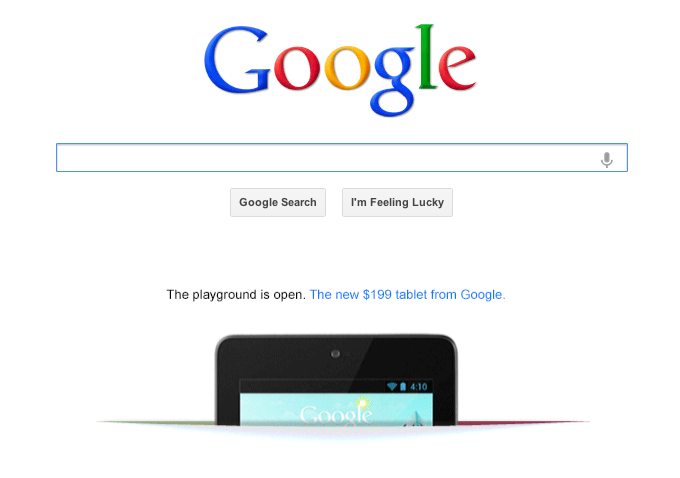
Only a couple of times has Google deigned to clutter its famously spartan home page with advertising. This is one of those times.

Today, Google is running an ad below its search box for the Nexus 7, the seven-inch tablet that it hopes will steal a march on Apple’s enormously popular iPads. Why now? Google hasn’t said, but it seems likely the ad push is looking ahead to Apple’s expected October release of the seven- to eight-inch iPad Mini, as well as to the expected announcement of Amazon.com’s new Kindle Fire next week.

As tablets take the computing market by storm, Google clearly views them as a critical device on which to make sure its search and other services, and the advertising that rides atop them, continue to be front and center. I remain doubtful about whether Google itself really wants to become a full-on maker of hardware, Motorola Mobility acquisition aside. But at the very least, a successful Nexus 7 could spark other manufacturers to pick up the pace of innovation in tablets.

That’s all the more critical in the wake of Apple’s big win in court last week, when Samsung was found to be infringing multiple Apple patents. Although Google’s underlying Android software was not directly involved, the jury’s ruling cast a pall on Android’s potential for further gains vs. the iPhone and the iPad.

The Nexus 7 spot marks a rare appearance of a Google ad on its home page, though not the first one. The company also ran ads for Motorola’s and Verizon’s Droid phone in 2009, followed by one for Google’s own Nexus One phone a few months later. It also has promoted other Google products, including the T-Mobile G1 phone in 2008. And just a few days ago, if you hovered over the “I’m Feeling Lucky” button, you got alternative messages that sent you to other Google services.

Still, don’t expect to see Google start splattering ads all over its home page. After all, then we’d all stop writing about how unusual it is and Google won’t get the free publicity it’s getting right now.

Five Reasons Apple May Not Dare To Sue Google

The official online color is: #A4C639 . 한국어: 공...

(Photo credit: Wikipedia)

From my Forbes.com blog The New Persuaders:

Now that Apple has scored a decisive win over Samsung in its smartphone patent trial, the big question is whether the maker of the iPhone and the iPad will go after the real enemy: Google. The search company is the maker of the Android software underlying Samsung’s and many other companies’ mobile devices, after all.

But a direct shot at Google looks unlikely at this point for a variety of reasons:

* Apple’s schoolyard bully strategy of going after the legal weaklings like Samsung worked like a charm, so it’s likely to continue going after hardware firms such as HTC and the now Google-owned Motorola Mobility, rather than Google directly. There are many other cases involving those companies, as well as Samsung, around the world–plenty to keep Apple busy, especially now that it has such a clear victory to build upon.

Indeed, patent expert Florian Mueller of FOSS Patents, a persistent Google critic, thinks Apple is more likely to go after Amazon.com first. As Mueller told Fortune’s Philip Elmer-DeWitt: “If I were in Apple’s shoes the next company I would sue is not Google, but Amazon, which has an even weaker patent portfolio than Google and sells large volumes of Android-based devices with a subsidies-centric revenue model, which is even more of a threat to Apple’s margins than Google’s advertising-based model.”

* Other hardware makers may now decide to settle with Apple, ratcheting down the need for Apple to go after Google. Analyst after analyst notes that with the clear loss for Samsung, the leader among Android device makers, other firms may decide it’s not worth continuing a fight they now seem more likely to lose.

* Apple looks less likely to win a patent infringement case versus Google. For one, Google itself mostly makes only software, and although its Nexus S device co-branded with manufacturer Samsung was identified by the jury as infringing Apple’s patents, it’s the only one and it’s not clear whether a single device provides a strong case for a separate suit. (It’s also not on Apple’s list of Samsung products it wants banned from sale.)

What’s more, Google doesn’t charge hardware companies for using Android, relying instead on ad revenues derived from Android device use, so there may not be much for Apple to sue about. Finally, let’s not forget that Android existed well before the iPhone came out–in fact, Google bought the company that made it in 2005, two years before the first iPhone. That doesn’t guarantee that whatever Google has done with Android since then is on firm patent ground, but it doesn’t seem a stretch to cast doubt in a jury’s collective mind that Android is simply copying iOS when Android the company clearly predates the iPhone.

Not least, Google has pockets deep enough to counter whatever legal threats Apple throws at it. Indeed, this ruling could well galvanize Google’s mostly passive efforts so far to protect Android hardware licensees. Apple may get all it wants from going after hardware producers, given that Apple makes most of its money from hardware itself.

* Apple has already gotten what it wanted from Google with this ruling: the likelihood that Google will have to change aspects of Android to avoid infringement, potentially reducing the competitiveness of Android devices. As Needham & Co.’s Charles Wolf writes: “Google will be forced to design workarounds of the violated software patents, which was the intent of Apple’s lawsuit, not the monetary award. These workarounds are likely to materially degrade the Android user experience relative to the user experience on Apple’s iOS operating system.”

* Google itself may start talking with Apple about some kind of way to avoid litigation. Wells Fargo Securities’ Maynard Um told investors in a note today that the $250 million or more that Apple could get in licensing fees from Samsung–not to mention additional fees from other device makers that may settle or lose in court as well–would be significant enough for Apple to be worthwhile. Add Google in there, and it may be a cash flow Apple can’t resist. After all, it apparently already offered a royalty deal to Samsung, whose rejection led to Apple’s suit.

One might wonder why Apple would feel the need to deal. …

Read the complete post at The New Persuaders.