Why Do Obama Supporters Appear In Facebook Ads As Romney Fans?

From my Forbes.com blog The New Persuaders:

Recently, I’ve been seeing a Sponsored Story ad on Facebook pages indicating that several friends “like” Republican presidential candidate Mitt Romney. No surprise there. Sponsored Stories are those personalized ads the social network allows advertisers to run that show friends have “liked” a brand, and they’re increasingly common as Facebook doubles down on social advertising.

But what on Earth was the name of a friend, who I know is a vocal Obama supporter, doing on a Romney ad? The answer raises questions about how effective, or at least how accurate, these ads are–not necessarily due to a particular fault by Facebook but thanks to the byzantine rules and privacy features that have developed over years of user outrage and resulting Facebook accommodations.

Anyway, I asked my friend if he knew he was shilling for Romney. His response:

“Lol…..I liked him so I could see his FB feed. You should read my comments.” [Hint: They’re not complimentary.]

To be clear, you can see Romney’s posts on his page without “liking” him, but to see them in your own news feed, you need to “like” him. And once you do, like it or not, you become potential fodder for an ad that will appear to your friends.

Another friend of a friend who’s an Obama supporter also was surprised to see his name on a Romney ad. He told his friend:

“I never liked his page. I commented on one of their crazy lies.. gave them a serious piece of my mind ya know!!!!! All kinds of people have been telling me why do u like Mitt???? I’m pissed!!!” …

Read the complete post at The New Persuaders.

Apple CEO Tim Cook Is Blowing Smoke When He Dismisses Rival 7-Inch Tablets

Apple Introduces iPad Mini... and some new com...

Apple’s iPad mini

From my Forbes.com blog The New Persuaders:

As a company that way more often than not comes out with superior products, Apple rarely appears defensive. Today was an exception.

On Apple’s fourth-quarter earnings call, CEO Tim Cook took repeated potshots at small tablets of the kind that–yes–Apple itself just debuted. The iPad mini is clearly aimed at blunting the appeal of seven-inch tablets such as Google’s Nexus 7 and Amazon.com’s Kindle Fire.

While I think Cook is probably right that the iPad will continue to dominate tablets, and even that it continues to make the best ones, his overenthusiastic criticism of seven-inch tablets struck me as surprisingly defensive. Saying Apple didn’t set out to build a “small, cheap tablet,” he called the competitors “compromised” products. “We would never make a seven-inch tablet,” he sniffed.

Why not? Because they’re too small, he said. The iPad mini is almost an inch larger, which means a 30% larger screen and 50% larger viewing area. I’ll grant that that is noticeable, and appealing.

But c’mon. These are all tablets you can hold in one hand, and acting as if the iPad mini is something utterly unique–“in a whole different league,” as he put it–comes off more than a bit desperate. Apple is clearly playing catch-up here, and trying to position the iPad mini as nothing like the Nexus 7 or Kindle Fire only serves to make us realize that Apple actually does feel threatened by these devices that beat it to what has turned out to be a real market. …

Read the complete post at The New Persuaders.

Facebook’s Mobile App Install Ads Get Moving

From my Forbes.com blog The New Persuaders:

Exhortations to install apps are likely a significant chunk of Facebook’s advertising revenues, and now they’re poised to become an even bigger factor in the social network’s future. Today, two months after offering app install ads for mobile devices to a select group of app developers and their marketing partners, Facebook opened up the ads to anyone.

These ads appear right in people’s mobile news feeds, providing prime placement for games and other apps in Apple’s App Store for iPhones and iPads and Google’s Play store for Android devices. Not surprisingly, Facebook says in a blog post that mobile app install ads are already working:

In early results, beta partners like Kabam, Fab, TinyCo and Big Fish were able to reach a more relevant audience and efficiently drive installs. For example, TinyCo saw 50% higher CTRs and significantly higher conversion rates compared to their current mobile channels, as well as a significant increase in player engagement.

A select subset of Preferred Marketing Developers (PMDs) has been testing mobile app install ads and saw similarly positive results. For example, Nanigans’ clients efficiently achieved 8-10x the reach compared to other mobile ad buys. Ad Parlor saw consistent CTR’s from news feed of 1-2% from engaged users looking for iPhone and Android games that their friends were playing.

No doubt those numbers will come down as the novelty factor in any new ad or feature wears off. Still, even a fraction of those results would still be valuable to advertisers.

That’s assuming–and this is a fair assumption given Facebook’s wariness about ad overload–that the company doesn’t go over the top and overload people’s mobile news feeds with the ads. Avoiding overload is especially important for these ads because unlike many of Facebook’s marquee ads, they don’t have a social component, meaning they appear strictly in response to developers paying for them, not because a friend liked an app.

Too many of these ads that don’t have the appeal of a friend’s connection, and the dreaded banner blindness is likely to set in.

There also more coming to improve these ads, according to Facebook engineer Vijaye Raji:

In coming months, we’ll continue to make updates that improve the user experience and the performance of mobile app install ads. For example, you may be able to customize your ad unit based on your audience, ensure that your ads are only shown to people who have not installed your app on iOS or Android devices, and allow people to start installing your app without leaving Facebook.

How Steve Jobs’ Laughable Early Apple Ads Evolved Into Today’s Marketing Marvels

From my Forbes.com blog The New Persuaders:

To look at Apple’s classic advertisements, from the stark, bold “Think Different” campaign to the playful “Get a Mac” series to those minimalist silhouetted iPod ads, you’d never guess that early Apple ads were so–not to put too fine a point on it–awful.

On the one-year anniversary of Apple cofounder Steve Jobs’ untimely death, we scrounged up a baker’s dozen of early Apple ads in the accompanying photo gallery for your amusement and edification. They’re print ads in particular, since it was pretty early days to be advertising computers on television. Still, most them wouldn’t be recognizable as Apple ads if not for the name and early logos.

They weren’t especially worse than other computer ads at the time. Maybe they were even marginally better. But they were anything but special, let alone cool.

What’s interesting is not just that Apple’s early ads look so depressingly conventional. It’s that a few of them revealed flashes of Jobs’ future marvels of marketing. Once Jobs got past the initial “speeds and feeds” marketing imperative during a time when Apple was really just one, albeit prominent, competitor in a sea of pre-Windows, pre-Mac personal computer makers, he began to develop an eye for brand marketing that few companies in technology or any other industry have since surpassed.

Take a close look at these early ads, and you can see that Apple’s evolution to the pinnacle of brand marketing happened not in a straight line, but in a sort of punctuated equilibrium that parallels the gradual maturing of computing itself. At first, PCs were for hobbyists interested in performance and features, and the ads reflected that. But as the machines began to sell into the millions, Apple’s ads began to emphasize how they were “the computer for the rest of us,” as the first Macintosh ads called them.

That first one for the Apple-1 in 1976, rivetingly entitled “A Balance of Features,” was appallingly amateurish. The ad, released only a few months after Jobs and Steve Wozniak showed the prototype at the Homebrew Computer Club in SiliconValley and incorporated their company, was stuffed full of technical features in a way that’s unimaginable today. For instance, the ad touted the ability to attach a keyboard and monitor to allow “the efficient entry and examination of programs in hexidecimal notation.” Who knew?

There was even a misspelling in the first line, a sign that Jobs’ famous perfectionism hadn’t quite kicked in yet. …

Read the complete post, including a photo gallery of the ads, at The New Persuaders.

Facebook’s New Gift Service: Nice, But Not Yet An E-Commerce Game Changer

From my Forbes.com blog The New Persuaders:

Just in time for prime gift-giving holidays like Friday’s World Rabies Day (or if you prefer, Ask A Stupid Question Day), Facebook today launched a social gift service. It’s rolling out to only a select few for now.

I must be one of them, because I was able to send something to my wife to try it out. But in its current form, I doubt I’m going to use it much.

This isn’t the 2.0 version of the Facebook Gifts virtual-gift service that the company shut down two years ago, by the way. In fact, the new Gifts is built upon, and run by, the folks at Karma, the gift-giving service Facebook acquired in May.

It actually looks pretty good. And while I have ordered precisely one gift that obviously has not yet been delivered, so I can’t judge the entire gift-giving process, it worked quite smoothly. I clicked on my wife’s Timeline, clicked the gift button, and off I went to order her some caramels. She can even pick her own flavor–that’s pretty cool.

In this case, I obviously know her address, so one advantage of Facebook Gifts–not having to know or ask for someone’s address–is moot in my case. What’s more, I didn’t get an automatic reminder I might get if it were her birthday, so that bit of friction elimination wasn’t a factor for me either. But it’s fast and easy to send gifts to friends, and that’s great–not just for consumers, but for Facebook, which can use a service that brings in revenues not dependent upon its brand of advertising that many large marketers are still doubtful about.

So what isn’t great, at least for me?

* A lot of the most prominent gifts are pretty vanilla–teddy bears, spa appointments, flowers, cupcakes. Maybe they’re fine products. Maybe they’re the sort of thing most people give their friends. But for a service with a tagline “real friends, real gifts,” too many of these products seem just too impersonal. Products, especially gifts, are not necessarily fungible, and all the less so for close friends for whom you’re supposed to be getting something special. And if they’re not close friends–and let’s be honest, most people don’t have several hundred close friends–I probably won’t be sending them many gifts, from Facebook or anywhere else. …

Read the complete post at The New Persuaders.

Apple’s New iOS 6 Ad Tracking Feature Is ‘Broken,’ Says One Source

From my Forbes.com blog The New Persuaders:

With the new iOS 6 operating software released with the launch of the iPhone 5 last Friday, Apple introduced a new version of a feature that allows advertisers to track phones to serve targeted ads. But it seems that for people who updated their iPhones via wireless networks, Apple’s new Advertising Identifier is not working.

That’s a big deal for advertisers, for which iPhones and iPads are a rich channel for mobile marketing. Without being able to identify users–or more accurately, their phones–they can’t track whether those ads produced a sale or other “conversion” such as an app installation. And they may not to spend a lot on iOS ads until they can do that again. “It’s crucial for the advertising market,” says Ravi Kamran, CEO of the apps marketing platform Trademob, which discovered the problem. “It drives the whole ecosystem.”

Apple’s new Advertising Identifier, which replaced a Unique Device Identifier widely seen as flawed from a privacy perspective, shows numerical IDs that are entirely zeroes instead of the usual unique sequence of numbers. In an interview, Kamran said the problem affects only those phones updated via WiFi, not via iTunes on a computer or via Xcode that Apple software developers use, but that’s a lot of people.

For the time being, advertisers will have to depend on third-party identifiers such as Open Device Identification Number, Kamran says. IPhone and iPad users who don’t like being tracked may be perfectly happy the Advertising Identifier doesn’t work. But the new identifier also offered a way to opt out of tracking, so ultimately a working Apple identifier is probably desirable for all concerned.

I’ve contacted Apple on whether it’s aware of the issue and what it may do about it and will update this post if and when I hear back.

Lots Of Blame To Go Around For Facebook’s IPO ‘Debacle’–But It Doesn’t Mean A Thing

Facebook CFO David Ebersman. (Photo: Wikipedia)

From my Forbes.com blog The New Persuaders:

When anything goes wrong, we just love a scapegoat, don’t we? Today’s scapegoat in the business world is David Ebersman, Facebook’s chief financial officer, who New York Times writer Andrew Ross Sorkin says is completely, solely, and utterly at fault for the social network’s underwhelming initial public offering and subsequent swoon in its stock price to less than half its IPO level.

Sorkin, as well as others, say Ebersman’s insistence on a higher stock price and especially on issuing more shares shortly before the offering were the key reason Facebook’s post-IPO shares not only failed to rise but steadily fell–vaporizing some $50 billion in shareholder value in the past 90 days.

But Ebersman is hardly the only culprit in the IPO. There’s also:

* Facebook’s underwriters, including Morgan Stanley and J.P. Morgan Chase. Not only did they go along with and even encourage the pre-IPO hype, but recently they cut their target prices for Facebook, contributing to today’s slide that knocked shares to under half the IPO level.

* Facebook investors. Business Insider’s Henry Blodget, who knows a little something about Internet stock dynamics, says investors willfully ignored both Facebook’s own warnings about advertising revenue uncertainties and CEO Mark Zuckerberg’s letter to, yes, investors, that he would focus on building Facebook’s services over maximizing its profits.

* Not least, CEO Mark Zuckerberg. After all, the buck (or in this case, 50 cents) stops here. While finances are probably at least third on the list of his concerns, behind Facebook’s services and its employees, a CEO ultimately is responsible for such a signature event in a company’s life.

Still, regardless of whom you might think is most culpable, in the end it probably will have little impact on Facebook’s prospects. That’s because there’s an even more fundamental reason to question the singling out of Ebersman: Perhaps Facebook’s IPO wasn’t really a debacle after all. …

Read the rest of the post at The New Persuaders.

Google Shuts Off TV Ads Business

From my Forbes.com blog The New Persuaders:

After five years of trying to sell ads on television using the automated buying system that works so well for its signature search ads, Google has finally given up. In a blog post this afternoon from Shishir Mehrotra, VP of YouTube and video, the ad giant said it will shunt the group’s staff to other projects:

Video is increasingly going digital and users are now watching across numerous devices. So we’ve made the hard decision to close our TV Ads product over the next few months and move the team to other areas at Google. We’ll be doubling down on video solutions for our clients (like YouTube, AdWords for Video, and ad serving tools for web video publishers). We also see opportunities to help users access web content on their TV screens, through products like Google TV.

The shutdown is clearly a disappointment for Google, yet another sign that its math-driven advertising systems don’t readily translate to traditional advertising. Back in 2009, the company shut down radio and print ad efforts for lack of interest.

Mehrotra’s not being entirely disingenuous when he says that Google’s efforts are better spent on online video advertising. After all, more and more TVs get connected to the Internet and more and more people watch TV shows on their laptops, smartphones, and tablets. With its Google TV project and its fast-growing YouTube video service, Google remains in a prime position to vacuum up ad revenues as big advertisers start to follow their audience onto the Web.

Indeed, YouTube especially has shown considerable traction in attracting new ad spending–$3.6 billion this year, by the reckoning of Citigroup analyst Mark Mahaney. As I wrote in a recent story, YouTube is where Google is placing its television-scale bets:

Now Mehrotra’s goal is to try to grab a big chunk of the $60 billion U.S. television business. But to do that, and fend off TV-content-oriented online rivals such as Hulu, YouTube has to become a bit more like conventional TV. To that end, it organized itself last year into TV-like channels, investing $100 million in cable-quality launches from Ashton Kutcher, Madonna, the Wall Street Journal, and dozens of others. More and more TV advertisers are being won over, says David Cohen, chief media officer at the media buying agency Universal McCann. “They’re getting marketers to think about YouTube as a viable outlet,” he says. 

Mehrotra, who last year became ­YouTube’s vice president of product, envisions millions of online channels disrupting TV, just as cable’s 400 channels disrupted the four broadcast networks. “We want to be the host of that next generation of channels,” he says.

In other words, Google’s strategy is to attack the TV ad business from where it’s strong instead of from where it’s not.

Why Do Programmers Hate Internet Advertising So Much?

Facebook ad question (Photo credit: renaissancechambara)

From my Forbes.com blog The New Persuaders:

Another week, another pontificating programmer slamming online advertising. What is it with these guys?

The latest example is a steaming heap of linkbait from software developer and entrepreneur Patrick Dobson entitled Facebook Should Fire Sheryl Sandberg. That would be the chief operating officer of Facebook, whose purported crime is that she steered Facebook toward being an ad-supported company.

In Dobson’s telling, while Facebook cofounder and CEO Mark Zuckerberg was off at an ashram in India, onetime Google ad exec Sandberg mandated that Facebook would henceforth be an advertising company. Proof of her folly? Facebook’s now worth half of what it was at its IPO three months ago as it “continues to flounder in advertising hell.”

This, despite the fact that Facebook will gross about $5 billion in ad revenues this year, despite the fact that its current market cap is still more than $40 billion less than eight years after the company’s founding in a Harvard dorm.

Thousands of Web developers would love to flounder this badly.

Dobson’s preferred alternative is that Facebook should gradually phase out advertising in favor of–and I have to get technical here, because the bigger picture he provides is fuzzy–selling access to its application programming interface. That way, developers can build businesses like Zynga did on top of the social network in the way personal computer software developers built applications atop Microsoft’s Windows. From his post:

… There is massive value in the social graph and the ability to build applications on top of it. I believe the value is greater than all of the advertising revenue generated on the web to date. … What is the best way to monetize the social graph? To sell access to the social graph! … Developers can then figure out if advertising, or micro transactions, or payed access is the best way to monetize the social graph.

I’m not really sure what “selling access to the social graph” would be, though it sounds like the result could make Facebook’s many privacy gaffes to date look tame.

But the bigger problem is the persistent implication by tech folks like Dobson that advertising is beneath them, and beneath any intelligent human being. Now, I’m no huge fan of most advertising, and all too often it is indeed lame. But there’s no doubt it can be useful at the right place and time, and even when it misses the mark, advertising is a small, remarkably frictionless price to pay for a whole lot of free Web services.

The notion that advertising is evil, to use a favorite term of Google critics, or at least useless is a longstanding meme in Silicon Valley. It goes at least as far back as Google’s founding, before it became–right–the biggest online ad company on the planet. Cofounders Larry Page and Sergey Brin famously wrote in their Stanford doctoral thesis describing Google that advertising could pollute search results.

Why this antipathy to advertising? A lot of tech folks seem to believe they’re immune to the influence of advertising. More than that, they assume that no one else is much influenced by it either (despite ample evidence over many decades that ads do influence people’s attitudes and behavior). Therefore, the reasoning goes, ads are nothing more than an annoyance, an inefficient allocation of capital. Dobson accuses Sandberg of a “rampant lack of business creativity” that has “no place in centers of innovation,” later saying she should start an ad agency in Miami. …

Read the complete post at The New Persuaders.

Here’s How Badly Google Wants To Make Nexus 7 Tablet A Hit

From my Forbes.com blog The New Persuaders:

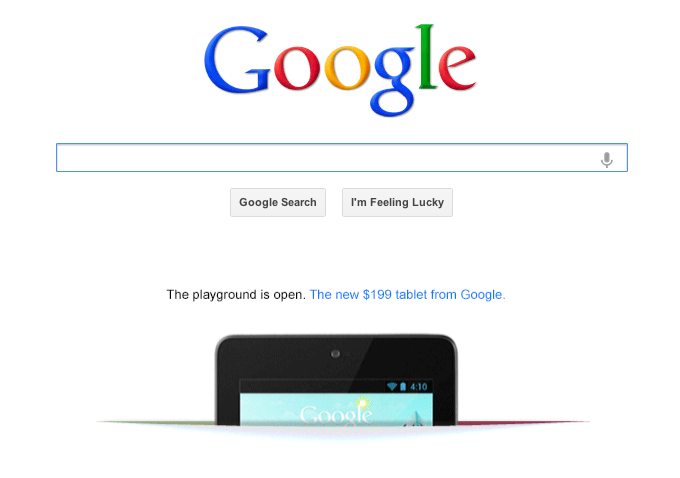
Only a couple of times has Google deigned to clutter its famously spartan home page with advertising. This is one of those times.

Today, Google is running an ad below its search box for the Nexus 7, the seven-inch tablet that it hopes will steal a march on Apple’s enormously popular iPads. Why now? Google hasn’t said, but it seems likely the ad push is looking ahead to Apple’s expected October release of the seven- to eight-inch iPad Mini, as well as to the expected announcement of Amazon.com’s new Kindle Fire next week.

As tablets take the computing market by storm, Google clearly views them as a critical device on which to make sure its search and other services, and the advertising that rides atop them, continue to be front and center. I remain doubtful about whether Google itself really wants to become a full-on maker of hardware, Motorola Mobility acquisition aside. But at the very least, a successful Nexus 7 could spark other manufacturers to pick up the pace of innovation in tablets.

That’s all the more critical in the wake of Apple’s big win in court last week, when Samsung was found to be infringing multiple Apple patents. Although Google’s underlying Android software was not directly involved, the jury’s ruling cast a pall on Android’s potential for further gains vs. the iPhone and the iPad.

The Nexus 7 spot marks a rare appearance of a Google ad on its home page, though not the first one. The company also ran ads for Motorola’s and Verizon’s Droid phone in 2009, followed by one for Google’s own Nexus One phone a few months later. It also has promoted other Google products, including the T-Mobile G1 phone in 2008. And just a few days ago, if you hovered over the “I’m Feeling Lucky” button, you got alternative messages that sent you to other Google services.

Still, don’t expect to see Google start splattering ads all over its home page. After all, then we’d all stop writing about how unusual it is and Google won’t get the free publicity it’s getting right now.