As Mobile Video Ads Soar At Facebook, Big Brands Pile In

Facebook CEO Mark Zuckerberg

Facebook CEO Mark Zuckerberg

From my Forbes blog:

Facebook’s second-quarter results today didn’t thrill investors, who knocked shares down more than 3% in after-hours trading. They don’t like to hear about an 82% jump in expenses to get revenue growth of half that much–even less so when Mark Zuckerberg, CEO and founder of the social network, says that spending won’t slow down much anytime soon.

But advertisers were a different story–in particular, big brand advertisers like Procter & Gamble and Under Armour that are looking to reach people via the mobile devices they carry with them all the time. Mobile ad revenues shot up 74% from a year ago, considerably faster than ads overall, which rose 55% after taking out currency impacts, and it’s now 76% of ad revenue.

In particular, Facebook is starting to become a must-buy for big brands that still spend the most on television, because it has the reach and the impact they want. Now, according to ad agency executives, they think Facebook is finally poised to capture more TV ad dollars that Chief Operating Officer Sheryl Sandberg has spent years pursuing.

“We see Facebook at a core pivot point,” says David Hewitt, VP and mobile lead at the digital agency SapientNitro. “It’s now a safe bet to put a lot of money into.”

In the last six to eight months, he says, brands have started to understand the reach Facebook has among smartphone users–some 844 million people each day. “It’s hard to get reach on mobile,” he says, but now “Facebook checks that box” in a way that few others online besides Google can. …

Read the rest of the story.

Twitter’s Temp CEO Jack Dorsey Sure Doesn’t Talk Like A Temp

Twitter CEO Jack Dorsey

Twitter CEO-for-now Jack Dorsey

From my Forbes blog:

On a wild day when investors couldn’t figure out whether they loved or hated Twitter’s second-quarter earnings, one thing was clear: Jack Dorsey is in charge.

At least for now. But during a blunt earnings conference call also broadcast on Twitter’s Periscope app, Dorsey sounded as if he’d really like to do the job much longer.

Dorsey, the temporary Twitter CEO who’s also CEO of soon-to-go-public Square, isn’t expected to get the permanent nod for the top job. Current speculation centers mostly on two people. One is Adam Bain, president of global revenue and partnerships, who can boast a better-than-expected performance on the advertising revenue front this past quarter as well as the undying love of the entire ad industry. The other is fast-rising Chief Financial Officer Anthony Noto.

Nonetheless, Dorsey sure sounded like an owner, not just a temporarily returning cofounder, throughout the earnings call. Plainly laying out how recent user growth initiatives haven’t worked, he said, “This is unacceptable and we’re not happy about it.” …

Whatever title Dorsey ends up with, it’s clear that he intends to drive Twitter’s future. “I’ve never been more sure of the value Twitter brings to our world,” he said at the close of the earnings call. And, it seems, never more sure that he’s the guy to prove it.

Read the complete post.

Have Scammers Hijacked Your Phone For Mobile Ad Fraud?

From my Forbes blog:

For years, scammers have been hijacking people’s computers into so-called botnets, opening hidden browser windows and automatically clicking on ads. That’s fooling advertisers and their ad agencies into thinking real people saw their ads, costing them billions of dollars a year in wasted spending.

Now, the fraudsters have started moving to mobile phones. Using a technique that one ad fraud detection company calls mobile device hijacking, the scammers use mobile apps such as games that run as many as 20 ads a minute, then simulate random clicks. Forensiq, a New York firm that provides ad fraud detection and prevention, today is releasing one of the first studies to look at the relatively new technique.

Already, the company says, more than 12 million devices have been infected–about 1% of devices Forensiq observed in the U.S. and 2% to 3% in Europe and Asia. Forensiq figures that the hijacking affects some 13% of all in-app advertising impressions.

The cost to advertisers is adding up quickly, Forensiq founder and CEO David Sendroff said in an interview. He projects that in-app ad fraud, which the company estimated at $857 million last year, will pass $1 billion worldwide this year.

Users generally don’t see any of this happening on their phone, at least not directly. But the apps–some 5,000 identified by Forensiq–still can be a plague on their phones. Forensiq found that in as little as an hour, a malicious app can download two gigabytes of images and videos, draining battery life and potentially burning through data limits. …

Read the rest of the post.

Unhappy With Google’s Mobilegeddon, Advertisers Spend More On Facebook

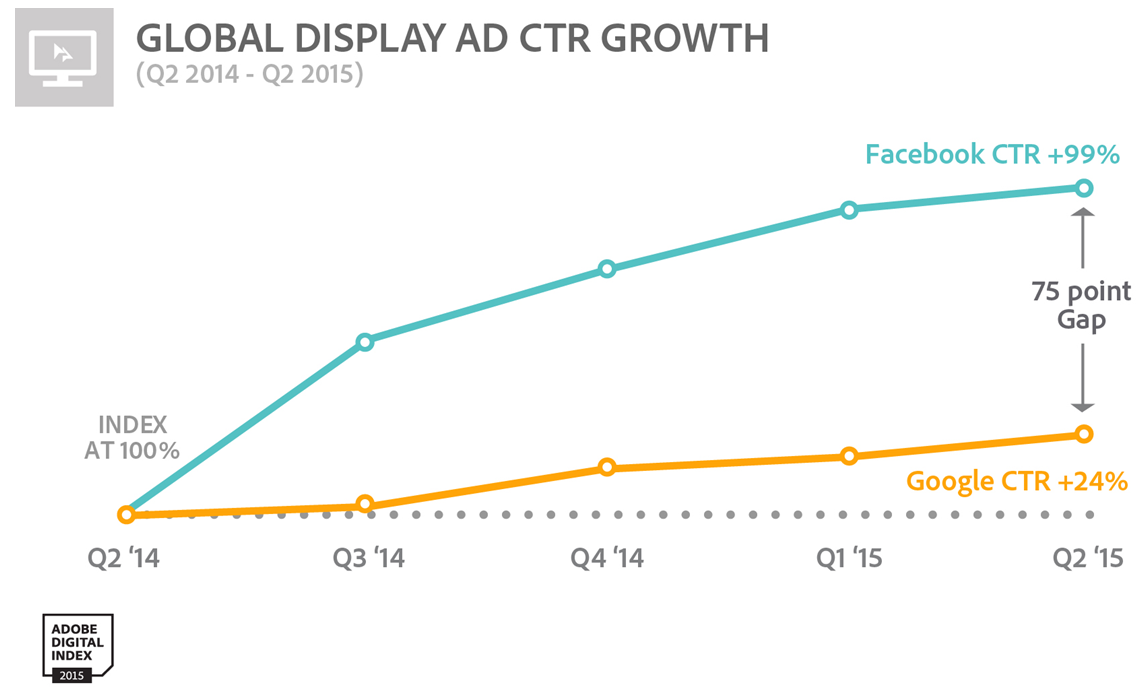
ADI_Global Display Ad CTR Growth

From my Forbes.com blog The New Persuaders:

When Google changed its formula for showing search results in April to favor websites it deems mobile-friendly, some businesses worried their sites would disappear from results. Mobilegeddon, as the algorithm change came to be called, was intended at least in part to spur publishers to quit sending people to sites that looked terrible or were downright unreadable on the smartphones where people spend more and more of their time online.

Perhaps that will happen eventually, but for now, according to a new report out today from Adobe, the change has indeed hurt brands that weren’t prepared. The Adobe Digital Index‘s second-quarter report on digital ads and social intelligence, which measures nearly a billion online ad impressions and 21 billion referred social visits from Facebook, Twitter, YouTube, and other social sites, shows that unprepared websites have lost 10% of their traffic compared with a year ago. And that decline is continuing to grow, says Adobe Digital Index principal analyst Tamara Gaffney.

Google has benefited, at least in the short term. Many marketers and ad agencies believe one clear goal was to boost mobile ad prices, which have continually lagged those of desktop computer ads. Indeed, prices measured as cost per click rose 16% from a year ago, according to Adobe.

But for marketers, the benefit is far less clear. Click-through rates on ads have fallen 9% from a year ago. “The bottom line is Google’s mobile business got better and marketers’ mobile business is getting worse,” says Gaffney. “They’re not getting the traffic they’re paying for.”

That situation obviously can’t last. …

Read the rest of the story.

Why Most People Won’t Pay To Block Mobile Ads

From my Forbes.com blog The New Persuaders:

There’s no shortage of people who claim they’d pay extra to avoid having to view ads on their favorite site, or anywhere on the Internet. One even took the trouble to suggest how it might work in a recent opinion piece in the New York Times.

But as a new survey shows, it’s very unlikely the vast majority of people would be willing to shoulder the real cost of replacing the ad revenues that would be lost–revenues required to keep Facebook, Google, the New York Times, and most other commercial sites running. According to the survey by the Palo Alto-based mobile ad marketing firm AppLovin, two-thirds of respondents aren’t willing to pay any extra at all for the privilege of wiping ads from their iPhones and Androids.

The survey, conducted last month, used Google Consumer Surveys to ask 5,000 U.S. residents between 18 and 65 how much extra they’d be willing to pay on top of their phone bill to remove ads. Besides those who wouldn’t pay a dime, some 14.5% said they’d pay an extra $2 a month, but those who would pay $5, $10, $15, or $20 extra each fall into the single digit percentages.

Clearly there is some demand for paid ad blocking. Problem is, the amount even those few are willing to pay doesn’t come close to making up the revenue difference, at least by AppLovin’s reckoning. …

Read the rest of the post.

3-D Imaging Firm Matterport Raises $30 Million For Mobile Push

From my Forbes.com blog The New Persuaders:

As virtual reality headsets such as Samsung Gear, Google’s Cardboard, and hotly anticipated devices from Magic Leap and Facebook’s Oculus Rift have gotten big press lately, one question is what we’ll actually do on these things besides play even cooler games.

Matterport, which last year started selling a $4,500 3-D scanning camera currently aimed mainly at real estate firms that want to provide a more immersive experience for potential buyers, hopes to enable a lot more applications to be created more easily. Today, the Mountain View-based company announced it has raised a $30 million Series C funding round led by Qualcomm Ventures to build out that vision.

The company plans to use the money in part to develop software to make it possible for almost anyone to capture 3-D content using future tablets and smartphones that incorporate 3-D sensors. In particular, CEO Bill Brown said in an interview, “We want to make it very easy for third-party apps to create and use this type of content.” Today, Matterport began accepting applications to its developer program.

As much buzz as Magic Leap, Oculus, and other VR devices have gotten, compelling content and apps will be key to making them the mass-market product that their makers keep insisting they will be. As Ben Miller, director of content development at WEVR, a VR studio in Venice, Calif., put it recently, there is no killer app for VR yet.

Matterport has found one that, if it isn’t a killer, is at least promising: real estate. …

Read the rest of the post.

Fetch Robotics Wins $20 Million Slug Of Funding Led By Softbank

From my Forbes.com blog The New Persuaders:

One of the most prominent robotics companies that hasn’t yet been bought by Google just got a new round of funding.

Fetch Robotics, led by CEO Melonee Wise, one of the leading young figures in robotics, today announced a $20 million Series A round led by SB Group US, a unit of Japan’s Softbank. Also joining in the round, which brings total funding of the company to $23 million, are current investors Shasta Ventures and O’Reilly AlphaTech Ventures.

In April, the San Jose-based company announced a pair of robots in April that are intended to help automate warehouses and fulfillment centers. Fetch’s Freight robot works with human pickers in a warehouse as they gather products to be shipped, following them carefully much like a faithful dog. Workers toss product into bins Freight carries, and when they’re full, it goes off to a shipping area and another can be summoned. The one-armed Fetch potentially replaces the human picker, at least for many kinds of objects, and can work with Freight for more autonomous operation of a warehouse. Each can return to a charging base automatically.

The 18-person company plans to use the money across the board, from sales and marketing to manufacturing to software development. “We’re hiring like crazy,” says Wise. …

Read the full story and interview with Wise.

Google Wants To Own Your Mobile Moments

googmoments

From my Forbes.com blog The New Persuaders:

For a few months now, Google has been pushing a new vision of advertising in the mobile age: Advertisers, it says, must capture the “micro-moments” when peripatetic consumers land on an app, a video, a website or anywhere else.

That’s increasingly important because despite today’s mobile first” mantra among tech companies and publishers alike, the fact remains that people use all kinds of devices throughout the day to find what they’re looking for online–their phone, their tablet, a laptop, a desktop computer, even an Internet-connected TV. What’s more, these people are often open to commercial messages for only short periods of time in just the right context: the age-old right-place, right-time, right-message but faster and more fleeting than ever.

And so Internet publishers and their advertisers need to reach not just faceless audiences but actual people, or at least detailed profiles attached semi-anonymously to real people. This “people-based marketing” is something Facebook has made huge coin on, and even companies such as Google are playing catch-up.

So today, Google is aiming to close some gaps in its powerful but (in the mobile age) rather less dominant advertising system. …

Read the rest of the story and interview with Google display and video ads VP Neal Mohan.

With Android Pay, Google Closes Gap With Apple In Mobile Payments

From my Forbes.com blog:

Apple vaulted ahead of Google in mobile payments last September when it announced Apple Pay, its long-awaited entry into mobile payments. By comparison, the three-year-old Google Wallet looked tired and limited.

Now, Apple’s head start has nearly vanished. Today at its I/O conference in San Francisco for software developers, Google introduced Android Pay, a successor to Google Wallet that, when it launches this summer, will come close to matching Apple Pay for making payments via smartphones easy in stores and inside apps.

They won’t quite be identical. Apple Pay’s security system is somewhat different, and Android phones won’t have fingerprint identification like Apple’s until the new version of Android comes out this summer, and even then only on phones that have fingerprint I.D. capability. But they’ll be close enough that consumers should be comfortable using either one in largely the same way–and at the very same 700,000 store locations that have the right checkout terminals.

That’s a big step forward for Google’s mobile payment ambitions. A competitive mobile wallet is key for the search giant because the ability to pay with a couple taps on a smartphone will grease the e-commerce skids for app developers and marketers alike.

If you’re tuning into the mobile payments business recently, you might wonder if Google is simply copying Apple. Actually, it’s more the other way around. …

Read the entire post.

The Top 10 Tech Trends Through 2020, From Five Top Venture Capitalists

techtrends2015

From my Forbes blog:

Get ready for the Skynet economy, the death of the car, and the re-emergence of women in tech.

Those are three of the top 10 trends coming in technology in the next few years, according to several top venture capitalists. They made their predictions Thursday night at a local Silicon Valley institution, the 17th annual top 10 tech trends dinner held in San Jose by the Churchill Club, which hosts forums with tech’s top executives, financiers, entrepreneurs, and thinkers. The criteria for the trends are that they must not be obvious (a rule frequently broken) and will be big in five years (also often broken).

Offering their prognostications at the event were Bill Gurley of Benchmark Partners (recently described by rival VC Marc Andreessen as “my Newman” after Jerry Seinfeld’s enemy), fast-talking science geek Steve Jurvetson of Draper Fisher Jurvetson, China-focused Jenny Lee of GGV Capital, early-stage investor Rebecca Lynn of Canvas Venture Fund, and former serial entrepreneur Shervin Pishevar of Sherpa Ventures. A few samples of what the VCs expect to see:

The virtual me: Lee thinks advances in hardware and sensors will create an explosion of data that will be aggregated into personal profiles that will know more about you than you do. Gurley says humans don’t want to be tracked that much, especially if the devices keep telling you what to do. Likewise, Jurvetson thinks these data-driven systems will be assistants more than taskmasters. And Pishevar suggests this data will work best if it’s made entertaining or gamified. Lee politely implies they’re all old.

The Skynet economy: Jurvetson sees universal broadband, via very low satellites, bringing untold amounts of talent into the global economy. Every part of the Earth would be equally covered with 16 GB a second Internet access by these now affordable satellites. This will profoundly change the lives of these people. Gurley is the main doubter, partly because he thinks it’s too big to invest in. Lynn waffles too, mostly because these people have bigger fish to fry, like, oh, keeping their babies alive. But Lee says wishing it comes true is part of making it come true.

Rise of the robocars: By 2020 we will no longer debate the inevitability of autonomous cars, Jurvetson predicts. They’re already safer than my parents and I trust them for my kids, he adds. There could be a 10 times reduction of vehicles, parking, etc. as well as a 10X reduction in traffic deaths.

The reemergence of women in tech: Half of computer science students will be women in five years, up from 10% now and a peak of 36% in 1984, argues Lynn. She blames the personal computer, which was targeted at males. Lots of pressure to change the situation. And more positive stories are being told, says Gurley. No one’s stupid enough to vote against this hot-button issue.

Overall winner with the highest percentage of audience votes: Rise of the robocars! So Jurvetson gets to wear the ceremonial wizard’s cape. Really, there’s a ceremonial red and blue wizard’s cape. “Do I have to wear it?” he asked. Yes, he did.

And then everyone drove off alone in their Teslas to buy stuff on their smartphone and pore over their binders full of women.

Read the rest of the 10 predictions.