Facebook’s Mobile App Install Ads Get Moving

From my Forbes.com blog The New Persuaders:

Exhortations to install apps are likely a significant chunk of Facebook’s advertising revenues, and now they’re poised to become an even bigger factor in the social network’s future. Today, two months after offering app install ads for mobile devices to a select group of app developers and their marketing partners, Facebook opened up the ads to anyone.

These ads appear right in people’s mobile news feeds, providing prime placement for games and other apps in Apple’s App Store for iPhones and iPads and Google’s Play store for Android devices. Not surprisingly, Facebook says in a blog post that mobile app install ads are already working:

In early results, beta partners like Kabam, Fab, TinyCo and Big Fish were able to reach a more relevant audience and efficiently drive installs. For example, TinyCo saw 50% higher CTRs and significantly higher conversion rates compared to their current mobile channels, as well as a significant increase in player engagement.

A select subset of Preferred Marketing Developers (PMDs) has been testing mobile app install ads and saw similarly positive results. For example, Nanigans’ clients efficiently achieved 8-10x the reach compared to other mobile ad buys. Ad Parlor saw consistent CTR’s from news feed of 1-2% from engaged users looking for iPhone and Android games that their friends were playing.

No doubt those numbers will come down as the novelty factor in any new ad or feature wears off. Still, even a fraction of those results would still be valuable to advertisers.

That’s assuming–and this is a fair assumption given Facebook’s wariness about ad overload–that the company doesn’t go over the top and overload people’s mobile news feeds with the ads. Avoiding overload is especially important for these ads because unlike many of Facebook’s marquee ads, they don’t have a social component, meaning they appear strictly in response to developers paying for them, not because a friend liked an app.

Too many of these ads that don’t have the appeal of a friend’s connection, and the dreaded banner blindness is likely to set in.

There also more coming to improve these ads, according to Facebook engineer Vijaye Raji:

In coming months, we’ll continue to make updates that improve the user experience and the performance of mobile app install ads. For example, you may be able to customize your ad unit based on your audience, ensure that your ads are only shown to people who have not installed your app on iOS or Android devices, and allow people to start installing your app without leaving Facebook.

Google Shuts Off TV Ads Business

From my Forbes.com blog The New Persuaders:

After five years of trying to sell ads on television using the automated buying system that works so well for its signature search ads, Google has finally given up. In a blog post this afternoon from Shishir Mehrotra, VP of YouTube and video, the ad giant said it will shunt the group’s staff to other projects:

Video is increasingly going digital and users are now watching across numerous devices. So we’ve made the hard decision to close our TV Ads product over the next few months and move the team to other areas at Google. We’ll be doubling down on video solutions for our clients (like YouTube, AdWords for Video, and ad serving tools for web video publishers). We also see opportunities to help users access web content on their TV screens, through products like Google TV.

The shutdown is clearly a disappointment for Google, yet another sign that its math-driven advertising systems don’t readily translate to traditional advertising. Back in 2009, the company shut down radio and print ad efforts for lack of interest.

Mehrotra’s not being entirely disingenuous when he says that Google’s efforts are better spent on online video advertising. After all, more and more TVs get connected to the Internet and more and more people watch TV shows on their laptops, smartphones, and tablets. With its Google TV project and its fast-growing YouTube video service, Google remains in a prime position to vacuum up ad revenues as big advertisers start to follow their audience onto the Web.

Indeed, YouTube especially has shown considerable traction in attracting new ad spending–$3.6 billion this year, by the reckoning of Citigroup analyst Mark Mahaney. As I wrote in a recent story, YouTube is where Google is placing its television-scale bets:

Now Mehrotra’s goal is to try to grab a big chunk of the $60 billion U.S. television business. But to do that, and fend off TV-content-oriented online rivals such as Hulu, YouTube has to become a bit more like conventional TV. To that end, it organized itself last year into TV-like channels, investing $100 million in cable-quality launches from Ashton Kutcher, Madonna, the Wall Street Journal, and dozens of others. More and more TV advertisers are being won over, says David Cohen, chief media officer at the media buying agency Universal McCann. “They’re getting marketers to think about YouTube as a viable outlet,” he says. 

Mehrotra, who last year became ­YouTube’s vice president of product, envisions millions of online channels disrupting TV, just as cable’s 400 channels disrupted the four broadcast networks. “We want to be the host of that next generation of channels,” he says.

In other words, Google’s strategy is to attack the TV ad business from where it’s strong instead of from where it’s not.

Here’s How Badly Google Wants To Make Nexus 7 Tablet A Hit

From my Forbes.com blog The New Persuaders:

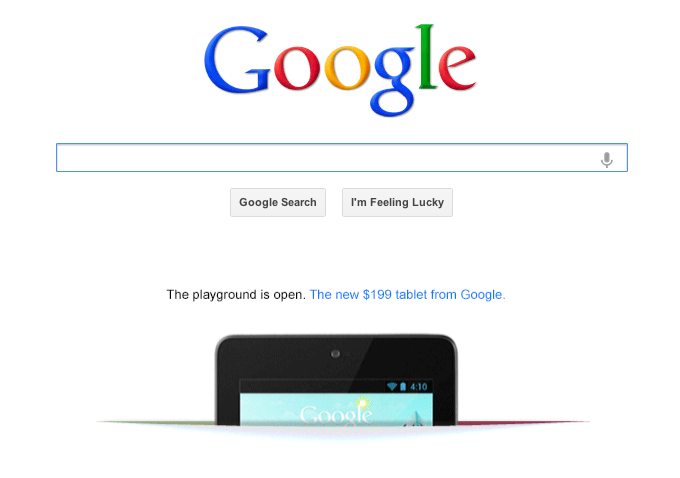
Only a couple of times has Google deigned to clutter its famously spartan home page with advertising. This is one of those times.

Today, Google is running an ad below its search box for the Nexus 7, the seven-inch tablet that it hopes will steal a march on Apple’s enormously popular iPads. Why now? Google hasn’t said, but it seems likely the ad push is looking ahead to Apple’s expected October release of the seven- to eight-inch iPad Mini, as well as to the expected announcement of Amazon.com’s new Kindle Fire next week.

As tablets take the computing market by storm, Google clearly views them as a critical device on which to make sure its search and other services, and the advertising that rides atop them, continue to be front and center. I remain doubtful about whether Google itself really wants to become a full-on maker of hardware, Motorola Mobility acquisition aside. But at the very least, a successful Nexus 7 could spark other manufacturers to pick up the pace of innovation in tablets.

That’s all the more critical in the wake of Apple’s big win in court last week, when Samsung was found to be infringing multiple Apple patents. Although Google’s underlying Android software was not directly involved, the jury’s ruling cast a pall on Android’s potential for further gains vs. the iPhone and the iPad.

The Nexus 7 spot marks a rare appearance of a Google ad on its home page, though not the first one. The company also ran ads for Motorola’s and Verizon’s Droid phone in 2009, followed by one for Google’s own Nexus One phone a few months later. It also has promoted other Google products, including the T-Mobile G1 phone in 2008. And just a few days ago, if you hovered over the “I’m Feeling Lucky” button, you got alternative messages that sent you to other Google services.

Still, don’t expect to see Google start splattering ads all over its home page. After all, then we’d all stop writing about how unusual it is and Google won’t get the free publicity it’s getting right now.

Five Reasons Apple May Not Dare To Sue Google

The official online color is: #A4C639 . 한국어: 공...

(Photo credit: Wikipedia)

From my Forbes.com blog The New Persuaders:

Now that Apple has scored a decisive win over Samsung in its smartphone patent trial, the big question is whether the maker of the iPhone and the iPad will go after the real enemy: Google. The search company is the maker of the Android software underlying Samsung’s and many other companies’ mobile devices, after all.

But a direct shot at Google looks unlikely at this point for a variety of reasons:

* Apple’s schoolyard bully strategy of going after the legal weaklings like Samsung worked like a charm, so it’s likely to continue going after hardware firms such as HTC and the now Google-owned Motorola Mobility, rather than Google directly. There are many other cases involving those companies, as well as Samsung, around the world–plenty to keep Apple busy, especially now that it has such a clear victory to build upon.

Indeed, patent expert Florian Mueller of FOSS Patents, a persistent Google critic, thinks Apple is more likely to go after Amazon.com first. As Mueller told Fortune’s Philip Elmer-DeWitt: “If I were in Apple’s shoes the next company I would sue is not Google, but Amazon, which has an even weaker patent portfolio than Google and sells large volumes of Android-based devices with a subsidies-centric revenue model, which is even more of a threat to Apple’s margins than Google’s advertising-based model.”

* Other hardware makers may now decide to settle with Apple, ratcheting down the need for Apple to go after Google. Analyst after analyst notes that with the clear loss for Samsung, the leader among Android device makers, other firms may decide it’s not worth continuing a fight they now seem more likely to lose.

* Apple looks less likely to win a patent infringement case versus Google. For one, Google itself mostly makes only software, and although its Nexus S device co-branded with manufacturer Samsung was identified by the jury as infringing Apple’s patents, it’s the only one and it’s not clear whether a single device provides a strong case for a separate suit. (It’s also not on Apple’s list of Samsung products it wants banned from sale.)

What’s more, Google doesn’t charge hardware companies for using Android, relying instead on ad revenues derived from Android device use, so there may not be much for Apple to sue about. Finally, let’s not forget that Android existed well before the iPhone came out–in fact, Google bought the company that made it in 2005, two years before the first iPhone. That doesn’t guarantee that whatever Google has done with Android since then is on firm patent ground, but it doesn’t seem a stretch to cast doubt in a jury’s collective mind that Android is simply copying iOS when Android the company clearly predates the iPhone.

Not least, Google has pockets deep enough to counter whatever legal threats Apple throws at it. Indeed, this ruling could well galvanize Google’s mostly passive efforts so far to protect Android hardware licensees. Apple may get all it wants from going after hardware producers, given that Apple makes most of its money from hardware itself.

* Apple has already gotten what it wanted from Google with this ruling: the likelihood that Google will have to change aspects of Android to avoid infringement, potentially reducing the competitiveness of Android devices. As Needham & Co.’s Charles Wolf writes: “Google will be forced to design workarounds of the violated software patents, which was the intent of Apple’s lawsuit, not the monetary award. These workarounds are likely to materially degrade the Android user experience relative to the user experience on Apple’s iOS operating system.”

* Google itself may start talking with Apple about some kind of way to avoid litigation. Wells Fargo Securities’ Maynard Um told investors in a note today that the $250 million or more that Apple could get in licensing fees from Samsung–not to mention additional fees from other device makers that may settle or lose in court as well–would be significant enough for Apple to be worthwhile. Add Google in there, and it may be a cash flow Apple can’t resist. After all, it apparently already offered a royalty deal to Samsung, whose rejection led to Apple’s suit.

One might wonder why Apple would feel the need to deal. …

Read the complete post at The New Persuaders.

How YouTube Turned Into a Real Business By Making Ads Optional

From my story in MIT Technology Review:

In 2008, when Shishir Mehrotra joined YouTube to take charge of advertising, the booming video-sharing service was getting hundreds of millions of views a day. ­YouTube, which had been acquired by Google in 2006, was also spending as much as $700 million on Internet bandwidth, content licensing, and other costs. With revenue of only $200 million, YouTube was widely viewed as Google’s folly.

Mehrotra, an MIT math and computer science alum who had never worked in advertising, thought he had a solution: skippable ads that advertisers would pay for only when people watched them. That would be a radical change from the conventional media model of paying for ad “impressions” regardless of whether the ads are actually viewed, and even from Google’s own pay-per-click model. He reckoned his plan would provide an incentive to create better advertising and increase the value for advertisers of those ads people chose to watch. But the risk was huge: people might not watch the ads at all.

Mehrotra’s gamble paid off. YouTube will gross $3.6 billion this year, estimates Citi analyst Mark Mahaney. The $2.4 billion that YouTube will keep after sharing ad revenue with video content partners is nearly six times the revenue the streaming video service Hulu raked in last year from ads and subscriptions. And that suggests Mehrotra has helped Google solve a problem many fast-growing Web companies continue to struggle with: how to make money off the huge audience that uses its service free.

In 2008, Mehrotra was working for Microsoft and hankered to have his own startup, but he agreed to talk to a Google executive he knew about working there instead. He decided against it—but that evening he kept thinking about how the exec was frustrated that most ad dollars go to TV, even though nobody watches TV ads. Yet at his Super Bowl party two weeks earlier, Mehrotra recalled, guests kept asking him to replay the ads. Was there a way, he wondered, to make TV ads as captivating as Super Bowl ads, every day?

The answer came to him in a flash. …

Read the complete story in MIT Technology Review.

Stung By Click Fraud Allegations, Facebook Reveals How It’s Fighting Back

From my Forbes.com blog The New Persuaders:

It’s a question that has haunted online advertisers since soon after Google perfected pay-per-click search ads a decade ago: Are those clicks from real potential customers, or are they from scammers draining my ad budget?

Now the issue of “click fraud” has hit Facebook full-force. On July 30, Limited Run, which provides software to enable bands and music labels sell physical products like records, said it was closing its Facebook account after finding that some 80% of the clicks it got during a recent ad campaign on Facebook were likely generated not by real people but by bots. Those are coordinated groups of computers hijacked by scammers or spammers, so any clicks they generate cost advertisers money for no benefit. (In a separate issue, in fact the main reason Limited Run said it’s leaving Facebook, the company also said Facebook asked it to spend $2,000 on ads in order to change its Facebook page name, something Facebook has said is not its policy.)

Limited Run said it came to the conclusion that the clicks were fraudulent after running its own analysis. It  determined that most of the clicks for which Facebook was charging it came from computers that weren’t loading Javascript, a programming language that allows Web pages to be interactive. Almost all Web browsers load Javascript by default, so the assumption is that if a click comes from one that isn’t, it’s probably not a real person but a bot.

To be clear, Limited Run isn’t charging that Facebook itself is responsible for those apparently fraudulent clicks. Often the culprits in click fraud are small-time ad networks and other outfits that pay people to click on Google and other ads they run on their sites, though that’s unlikely to be an issue for Facebook, which does not yet run its ads outside its own site as Google and others do. Perhaps, Limited Run has suggested, rivals could be using the bots to cost the company money by forcing it to pay for useless clicks.

The click fraud issue has at times loomed large for Google and other companies because of the potential impact on advertiser trust, and Google continues to fight click fraud–as does Facebook. Indeed, the issue isn’t new for Facebook either, with complaints, including lawsuits, bubbling up since at least 2009.

But while click fraud doesn’t seem to have driven away a large number of Google advertisers, whether because the company has minimized it or because advertisers simply factor it in as a cost of doing business online, the issue is a particular concern for Facebook now. It’s trying to prove to skeptical advertisers and investors that its ads work, and claims that there’s rampant click fraud don’t help. At the same time, Facebook has said recently that some 1.5% of its nearly 1 billion accounts are “undesirable,” meaning “user profiles that we determine are intended to be used for purposes that violate our terms of service, such as spamming.

Facebook has declined to say much about the Limited Run situation, though the company says it believes it catches and filters out the vast majority of “invalid clicks” before they’re even charged to advertisers. Its own page on “click and impression quality” doesn’t reveal much detail about how it deals with click fraud, however, so I asked the company for more insight on what it’s doing about the problem.

Mark Rabkin, an engineering director on Facebook’s ads team, responded to questions by email. While at times he’s repeating what Facebook has said before, he also reveals that the company has a growing staff of 300 people working on security and safety and explains in more detail the various ways the company tries to catch bad clicks. Here are his answers. …

Read the complete interview at The New Persuaders.

Why Google May Be Secretly Happy That Apple’s Dropping Its YouTube App From Next iPhone

From my Forbes.com blog The New Persuaders:

OK, so Apple will drop its YouTube app from iOS 6, the new version of its iPhone operating system due out this fall. Cue loud and histrionic coverage about Apple’s thermonuclear war, as the late Apple cofounder Steve Jobs put it, vs. Google and its Android mobile software.

Except it seems likely that script is off the mark. Here’s why: Most people may not realize it, but that YouTube app on their iPhones is actually designed by Apple, a holdover from the iPhone’s introduction in 2007, when all the apps were Apple’s and YouTube was a big draw. (So big that one of Apple’s original iPhone ads highlighted YouTube, as in the video above.) Problem is, since then, Apple has appeared to do relatively little to advance the app, which now looks old (almost as old as that TV used in the app’s icon, at least on my impossibly old iPhone).

Even more important from the point of view of Google and the pro content producers on YouTube, the Apple YouTube app doesn’t allow ads to be run against all those billions of videos views a month that YouTube draws on mobile devices. So search for “Lady Gaga” on your iPhone and what do you see? Well, Lady Gaga, but very little from official channels such as ladygagaofficial, which means very few official videos. Contrast that to a search on “Lady Gaga” on YouTube.com, and official videos are there, along with ads all over the place.

Why the huge difference? Because she can’t run ads on the iPhone YouTube app, and no ads means no money generated. Multiply that by thousands of artists, movies, and all kinds of content that advertisers want to run ads against–ads that will bring in up to $3.6 billion in revenues this year, by Citigroup analyst Mark Mahaney’s recent estimate for YouTube. Now you realize why Google may not mind much that the creaky old adless Apple app is heading for the trash can icon.

Read the complete post at The New Persuaders.

Why Google’s Nexus 7 Tablet Is Hotter Than Apple’s iPad

Cross-posted with some changes from my Forbes.com blog The New Persuaders:

For once, an Apple product isn’t the hottest piece of hardware on the scene. This week, at least, that highly enviable status goes to Google’s new Nexus 7 tablet.  According to reports, several retailers are sold out of the 7-inch tablet, and even Google’s own online store only has the cheaper, $199 8-GB version. The $249 16-GB version is no longer available anywhere except on eBay for a steep premium.

Of course, you have to remember that selling out doesn’t mean much without knowing how many sold out. This is a classic Apple ploy, though to give Apple credit, it usually turns out later that it sold a ton of whatever sold out. No matter, selling out a product shortly after its release still works great as a marketing tool, as you can see from the coverage gushing about “incredible demand.”

But Google deserves credit for more than just marketing. Now that I’ve tried it for several weeks, with a model provided temporarily by Google at its I/O developer conference, I can tell you why the Nexus 7 is the latest hot gadget:

* It looks and feels, to use the technical term, slick. The fact is, Apple’s products have a look and feel that few can match, and even the Nexus 7 doesn’t quite get there. But it’s pretty damn close. It feels substantial, while substantially lighter, of course, than the iPad. The swiping is very smooth as well.

* The 7-inch size is appealing and convenient. It’s easy to hold it in one hand, while swiping with the other. It also fits in a pants or shorts pocket (or purse, I’m guessing) surprisingly well for temporary transport. So I end up taking it more places than my larger tablet.

* The screen is no Retina like the latest iPad, but it still looks sharp and bright.

* It may not have all the apps, or some of the latest and greatest, that Apple has, but it’s got plenty. And some very nice ones, too, such as Flipboard and my current favorite, The Night Sky.

* Almost forgot–it’s cheap! For $199, it’s less than half the current $399 minimum for an iPad. That makes the Nexus 7 close to an impulse item, or at least a gift that won’t break the bank.

* Uber-reviewers Walt Mossberg of the Wall Street Journal, David Pogue of the New York Times, and even Apple fanboy/Google hater MG Siegler, himself, all like it. So does almost everyone else.

For all that, I can’t help mentioning the downsides. The default screens are a mess of apps, My Library (which features an Esquire cover of Bruce Willis that I really don’t want to see anymore), and recommended apps and magazines I couldn’t care less about (Country Weekly magazine? Really?). You can change the app organization, but at the outset, it’s haphazard, making it hard to find some basic ones at first. In particular, the nondescript icon for Google Play, which seems really key to Google’s ultimate success at mobile devices and apps, doesn’t suggest an app store. And who besides us Google watchers know that “Google Play” is an app store anyway?

As many have noted, there’s not much content in its Google Play store. But that means little to me because I’m a Netflix subscriber and can watch using the Android App. There’s also a Hulu Plus app. (But not Amazon Instant Videos via my Prime subscription, at least not without browser tweaks few will want to bother with; that may be a deal-killer for big Amazon video fans.) The device doesn’t have a rear-facing camera. Since I’m not using a tablet to take photos (partly because, in what is a weird omission, there is no built-in camera app), and since Skype is one of the killer apps as far as I’m concerned, the single front-facing one works fine for me. It’s WiFi only, though again, I wouldn’t pay for another monthly data plan anyway. And with only 8 or 16 GB of storage, you better be comfortable storing most of your stuff in the cloud (I am).

Finally, there’s apparently a problem with the touchscreen, though I haven’t run across it yet, that’s especially a problem for playing games. My own minor complaint about the screen, which I haven’t seen mentioned in reviews I’ve read, is that it’s just a tad too small, or at least the border around the screen is. It’s hard to pick up along the side, because too often I end up touching an icon and launching an app or stopping a video when I don’t want to. The recessed side buttons are a little hard to reach sometimes, too. These are quibbles, though.

Meanwhile, it looks like Apple is readying its own smaller iPad for under $300. That could well steal the Nexus 7’s thunder–especially since it almost certainly will do two or three things better than the Nexus 7 because it’s Apple and because it will be newer.

But for the next few months, at least, Google has a bona fide hit on its hands. And for all the right reasons, not just manufactured scarcity.

Read the original post at The New Persuaders.

For Once, Google Tops Apple: Today’s Death-Defying Demo

From my Forbes.com blog The New Persuaders:

Apple is legendary for its demos at its software developer conferences, introducing products that surprise and delight the crowd and then consumers. Even with the passing of cofounder and master showman Steve Jobs last year, Apple will likely continue to set the gold standard in launching products in the most public and desire-inducing way.

Google? It’s known more for rather geeky demos, and even one or two that didn’t work very well, like the demo of Google TV two years ago.

Today, however, it outdid itself–and even more amazing, outdid Apple. Reminiscent of Jobs’ famous “one more thing” announcements, Google cofounder Sergey Brin bounded onto the stage at the Google I/O conference keynote to “interrupt” VP Vic Gundotra with a demo of Google Glass, those wearable computer glasses he has been seen wearing in the last few months.

But this wasn’t just any demo. Google had a few people in an airship wearing the glasses, and when they looked down on San Francisco, it was pretty cool in a vertiginous sort of way.

Then it became apparent that these guys (and a woman) weren’t going to stay in the airship for long. They were going to jump. Over a heavily populated city. Onto the roof of the very conference center where Brin and 5,000 engineers were gathered. …

Read the complete post at The New Persuaders.

Google Makes Renewed Grab for the Rest of Online Advertising

New DoubleClick ad system heats up battle to create an operating system for digital marketing

Cross-posted from my Forbes.com blog The New Persuaders:

It wasn’t supposed to be this way. Hundreds of well-funded online ad technology companies have sprouted up in recent years, each aiming to make it easier and more efficient for marketers to reach just the target audience they want.

Terence Kawaja, CEO of boutique investment bank Luma Partners, created this now-famous Display Lumascape to show how complex the online ad tech industry has become.

Yet the result is a crazy quilt of companies–graphically illustrated in that mess of a chart on the right–that drives marketers and agencies crazy. The very existence of so many competing products, in fact, has made placing ads online and measuring their impact more complicated and cumbersome than ever. “Venture capital has supported and financed a bunch of chaos,” advertising veteran Randall Rothenberg, CEO of the trade group Interactive Advertising Bureaugriped at a recent ad conference.

The result: Most ad dollars, nearly $200 billion a year, still get spent on television because it’s so much easier.

That’s the problem Google aims to solve with a revamped ad buying system it will announce today at a private Future of Advertising event hosted by its DoubleClick display-ad management and technology unit. (Part of the event will be livestreamed here.) The company, which already dominates 60% of the online ad business–those little text ads that appear on the right and top of the page when you do a search–now has its sights set on the remaining 40% of the industry. That would be the $25 billion worldwide market for display ads, the graphical and video banners familiar on virtually every commercial website.

Google’s goal: Provide the leading one-stop shop for advertisers and publishers to buy ads on websites, mobile phones, social networks, apps, and whatever other new media the Internet spawns. Essentially, it’s building an operating system for ads much like Microsoft did with its Windows for PCs–with much the same appeal to marketers and agencies as Windows has for PC users. “When you’re putting together a campaign, you want everything connected vs. trying to piece it all together,” says Kurt Unkel, president of the online ad buying operation at Publicis Groupe’s VivaKi digital ad agency, a Google partner.

Google’s announcement is the latest salvo in a war to control the next era of digital marketing. After a decade in which Google’s search ads overtook display ads with an unmatched ability to turn clicks directly into sales, many advertisers and publishers expect–or at least hope for–a resurgence of new kinds of display ads that could woo brand advertising dollars from TV. Neal Mohan, Google’s vice president of display advertising products, has predicted that display will be a $200 billion industry in a few years.

Read the rest of the story at The New Persuaders.