Apple Pay Has Finally Arrived! Great – But Here Are 7 Reasons It Won’t Be A Slam-Dunk Success

applepay

From my Forbes blog:

Judging from most of the coverage of  Apple Pay, the mobile wallet that launches Monday, you’d think Apple has already revolutionized the $4 trillion U.S. payments market before anyone has even used it in the wild.

It does look pretty slick, at least based on Apple’s own demonstration at the Sept. 9 event where it also debuted two iPhone 6 models and the Apple Watch. All that’s required to buy a burger and fries at McDonald’s or a tank of gas at Chevron, Apple CEO Tim Cook promised, is to hold an iPhone near a wireless reader at the checkout counter and press a thumb on the home button to activate Apple’s Touch ID fingerprint sensor. In under 10 seconds, you’re out the door.

That would be a stark contrast to today, when using a mobile wallet from Google, PayPal, and others requires unlocking a phone, typing in a number, checking into a store, and various other steps–including waiting to see if it even works and trying another time or two when it doesn’t. Many merchants don’t even have checkout people who can tell you how it works. In several attempts in the past week or so, I went two for four: Google Wallet worked at Peet’s and Walgreen’s, though only after a couple of attempts, PayPal didn’t work at a local cafe where it was supposed to, and CVS didn’t work with either one. Even the clerk there didn’t know how the reader at the checkout counter worked.

But based on research into rival wallets and interviews with merchants, payment tech firms, and payments experts, it’s apparent that Apple Pay is far from a guaranteed success–at least if you judge success on what Apple CEO Tim Cook promised last month: “Apple Pay will forever change the way all of us buy things.” Here’s why there’s good reason to view Apple Pay with skepticism:

* You can’t use Apple Pay unless you buy an iPhone 6 or 6 Plus. Apple uses a method to send data from a phone to a checkout reader called Near Field Communication, which is used in some 220,000 retail locations already for other wallets and new credit cards that use a chip to store information. Previous iPhone models didn’t have NFC, so you can’t use them (except for iPhone 5 models along with an Apple Watch, but not until next year). So not only is Apple Pay limited to iPhone users, it’s limited only to iPhone 6 buyers, who number at least 10 million so far and perhaps double that by the end of December.

That may well be enough to jumpstart Apple Pay usage and finally make the long-awaited mobile wallet a reality–for iPhone users. But no store will want to turn away users of Android or other phones who see the iPhone owner in front of them in line whisk through with a tap. “Merchants won’t want the PR hit of discriminating against Android users,” says Richard Crone, CEO of payments advisory firm Crone Consulting, who notes that there have been 50 million downloads of branded merchant apps and 90 million active banking app installs. “This will cause them to get religion quick around their own mobile wallet.”

* Cash and credit cards just aren’t that hard to use. Everyone takes cash, and most places of any size accept credit cards. Credit cards also survive getting wet or hot or sat on much better than phones. As payments expert Bill Maurer, dean of the School of Social Sciences at the University of California at Irvine, said in my Apple Pay story, “All of these mobile wallets are looking for a problem to solve.” …

Read on for more challenges facing Apple Pay.

With IdeaMarket, Idealab’s Bill Gross Wants To Create 1 Million Startups

From my Forbes blog:

You might wonder if perhaps there are a few too many startups these days, especially if you’re trying to rent a place in San Francisco or buy a house in Palo Alto. Bill Gross doesn’t–not one bit.

Gross’ Los Angeles tech startup incubator Idealab has created more than 125 since its founding in 1996, 40 of them making it to IPO or acquisition. But the company’s founder and CEO thinks he has come up with a way to multiply that sum by about 8,000, to as many as 1 million startups eventually. The new company he’s announcing this morning at the TechCrunch Disrupt startup-launching conference in San Francisco, IdeaMarket, is intended to be a startup marketplace that matches ideas with investors and especially entrepreneurs. “IdeaMarket is the culmination of my whole life,” Gross said in an interview. “It’s turning what I do into a machine.”

Something of a mashup of Kickstarter, Quirky, and XPrize, as well as Y Combinator and other incubator/accelerators, IdeaMarket will let anyone post an idea for a product or service that they don’t have the resources or desire to pursue themselves. They can invest in it, and so can other accredited investors, who may offer, say, $100,000 apiece to entrepreneurs who want to take the idea and run with it. An entrepreneurial team submits a plan for how they’d do that and the investors or IdeaMarket interview the candidates to make a choice. Visitors to the site can vote on them or suggest improvements, or even invest in them once they get accredited.

So far, prominent investors and tech figures have come up with more than 20 ideas. Listed already among 17 ideas with a combined $2.7 million in committed funding are a 3D printer than can print glasses lenses (from Index Ventures cofounder Neil Rimer); an app that tracks your app usage and puts the most-used ones at the top of your smartphone screen (from Google developer advocate Don Dodge); an Uber for trash pickup called Trashnado (from entrepreneur and angel investor Scott Banister); pizza delivery robots (from Gross himself) and (saving the strangest for last), Pray It Forward, “a web-based marketplace for people in times of trouble to quickly tap into the power of group prayer by connecting them with people who will pray for them” (from Affirm cofounder and CEO and former PayPal cofounder Max Levchin). They’re all also investors, along with others such as SherpaVentures cofounder and managing partner and former Menlo Ventures managing partner Shervin Pishevar.

While you can imagine IdeaMarket might spur yet another round of apps that we probably have too many of already, most of which will either wither or get sucked up by Google, Facebook, and the like, Gross is clearly hoping for more groundbreaking ideas as well. …

Read the rest of the story.

Interview: Inside Google Brain Founder Andrew Ng’s Plans To Transform Baidu

Baidu Chief Scientist Andrew Ng

Baidu Chief Scientist Andrew Ng

From my Forbes blog:

Little known outside China, the Chinese search engine Baidu scored a coup earlier this year when it hired Andrew Ng to be chief scientist and open a new artificial intelligence lab in Silicon Valley. Ng, a Stanford computer science professor who headed the Google Brain AI project and then cofounded the online education startup Coursera, is the foundation for Baidu’s plan to transform itself into a global power.

In two wide-ranging conversations at Baidu’s still mostly empty Silicon Valley Artificial Intelligence Lab in Sunnyvale, adjacent to the rocket scientists at NASA’s Ames Research Center, Ng and his lab chief Adam Coates recently outlined their plans at Baidu and their vision of what AI can accomplish. That, as I outlined in a story on those plans, includes everything from improved speech recognition to much smarter robots to truly intelligent personal assistants.

Ng, who speaks in an extraordinarily gentle voice that compels close attention by the listener, seems to realize how much he has to prove, both vs. fast-rising Chinese rivals such as soon-to-go-public Alibaba and global forces such as Google and Facebook that are also betting big on AI, in particular the fast-emerging branch of AI called deep learning. Even before being asked, Ng sought to quash what he called the “stereotype” of Chinese companies as mere copycats of U.S. and other technology companies.

In Baidu’s case, at least, the stereotype may be superficial. But it also seems clear that Ng’s hiring is part of an attempt by Baidu, often called “China’s Google,” to create world-beating technologies that will elevate it to the top tier of global innovators. In this edited version of the interview, he reveals plenty of details about how he plans to help make that happen.

Q: How did you get interested in artificial intelligence?

A: I just thought making machines intelligent was the coolest thing you could do. I had a summer internship in AI in high school, writing neural networks at National University of Singapore–early versions of deep learning algorithms. I thought it was amazing you could write software that would learn by itself and make predictions.

If we can make computers more intelligent–and I want to be careful of AI hype–and understand the world and the environment better, it can make life so much better for many of us. Just as the Industrial Revolution freed up a lot of humanity from physical drudgery, I think AI has the potential to free up humanity from a lot of the mental drudgery. …

Read the rest of the interview.

‘We Are Going For Change’: A Conversation With 23andMe CEO Anne Wojcicki

From my Forbes blog:

After spending seven months in the Food & Drug Administration’s penalty box, the consumer genetics testing firm 23andMe recently submitted a new health-related test for FDA approval.

It was a significant step following last November’s FDA slapdown of 23andMe’s genetic tests, which included health reports outlining customers’ chances of getting a wide variety of diseases from celiac to melanoma. In a sharply worded warning letter, the FDA said the $99 tests, analyzed from a vial of customers’ saliva, constituted a medical device under its regulations, and the company needed to get explicit approval for providing risks of getting specific diseases.

Although the partly Google-funded company continued selling the tests along with ancestry data, there’s no guarantee that it will be able to resume offering even a few health reports. And even if it does, the FDA’s approval process likely will take many months. But the new submission is a sign that CEO and cofounder Anne Wojcicki is continuing her drive to reinvent healthcare by putting more information, in 23andMe’s case genetic makeup and its impact on diseases and other conditions, directly into the hands of consumers.

Specifically, she aims to speed up medical research by creating a research portal with genetic data combined with surveys it does with customers to give researchers a much easier way to see what genetic variants are associated with what diseases. With this sort of Google for genetics, pharmaceutical companies might be able to create treatments much faster. The company is already teaming with pharma companies on such research, such as an agreement announced Aug. 12 with Pfizer to research potential genetic factors associated with inflammatory bowel disease.

For a recent story on 23andMe’s attempt to get back on track, I talked with Wojcicki twice, most recently in mid-June, just as the company was preparing to submit a new health report on Bloom syndrome for FDA approval. Winded after she rode an ElliptiGO bike five miles into the company’s office in Mountain View near Google, she explained how she intends to get FDA approval and move ahead on what she says is a 10-year goal of revolutionizing healthcare. Following is an edited version of the conversations, which covered the company’s strategy for FDA approval, 23andMe’s business model, Wojcicki’s longer-term goals, and the challenges she faces.

23andMe CEO Anne Wojcicki

23andMe CEO Anne Wojcicki

Q: You’ve been talking more publicly of late than you had in months past, and you haven’t toned down your critique of the medical establishment. What should we read into that?

A: I still think the medical establishment has a lot of problems. Not much has changed. So we made a very conscious choice that we are going for change. It’s expensive. We have a high burn rate and our sales have been hit. But we’re sticking to it. We need to comply with the FDA and we need to show them validity.

Q: What’s the status with the FDA right now?

A: They’re a very willing partner. We are extremely lucky in the sense that when we call them, they call us right back. I think that they genuinely want to make this all work. I really do believe there’s that genuine partnership with them.

[FDA Commissioner] Peggy Hamburg wrote in a New York Times [opinion piece] that the FDA is committed to finding a path to direct-to-consumer [genetic tests]. I do believe there is a genuine intention to try to find a path. It’s probably not going to be exactly what we wanted and it’s going to take time. In Silicon Valley, you want things done instantly. It’s not going to be that. But we’ve learned that. We’re going to figure out some kind of path.

Q: What was the problem with simply applying for approval in the first place?

A: We’ve been very clear from Day One that we’re a little bit of a square peg in a round hole.

Read the rest of the interview.

Startup Ersatz Labs Launches Deep Learning AI In The Cloud (Or In A Box)

From my Forbes blog:

Deep learning, a branch of artificial intelligence that has led to recent breakthroughs in automated image and speech recognition, is the hot new technology among tech giants from Google and Facebook to Microsoft and China’s Baidu. They’ve been spending hundreds of millions of dollars to buy companies and vacuum up talent from universities that are all working on deep learning neural networks, which attempt to mimic how the brain works to improve computing performance on tasks humans do with ease.

Now, a San Francisco startup called Ersatz Labs is formally launching what it calls the first deep learning platform, one that it says any company or researcher can use to do deep learning on the (relatively) cheap. It’s being offered as a service in the cloud and, for companies that want or need to do what can often be mission-critical work inside their corporate network firewall, as a hardware appliance with software installed.

Either way, the upshot of the service is that a whole lot of companies may be able to apply deep learning to their own services to achieve similar breakthroughs to Google’s, Microsoft’s, and others’. The service has been in beta for the past year with 2,200 customers, from Wall Street traders to researchers looking to detect tumors on mammograms to energy companies analyzing seismic data to an iPhone app maker using accelerometers to determine if you’re exercising correctly. “The deep learning methods are established enough that you don’t have to build this all yourself,” says Ersatz Labs CEO Dave Sullivan, cofounder with Chairman Ronjon Nag, who also provided $250,000 in funding. …

Read the rest of the story.

Sorry, But Twitter Will Never Be Facebook

From my Forbes blog:

Twitter’s shares look to stage another swan dive Wednesday morning as investors continue to focus on the only disappointing piece of data in its first-quarter earnings report: continued anemic user growth.

Higher growth would be better, of course. But the clear implication of an after-hours selloff of 11%, to a little under $38 a share, is that Twitter needs to be more like Facebook: Only by growing like crazy, the thinking goesFacebook-crazy, that is–can Twitter build the next great online media business.

On that point, investors are utterly wrong. If anything, Twitter needs to make sure it doesn’t try to be more like Facebook.

Now, that could well mean that Twitter will never grow to Facebook’s size. That would indeed be disappointing to many. When investors bought into Twitter’s initial public offering last year and ultimately drove shares to a closing high of $73.31 the day after Christmas, that potential is clearly what they were buying.

Twitter_logo_blue

But that’s their mistake. It’s no knock on Twitter as a potentially very successful advertising medium. After all, ad sales more than doubled in the quarter. And with a number of still-nascent ad products waiting in the wings, there’s little reason to think that growth–you know, revenue growth–won’t continue or even accelerate.

The problem is that most investors and advertisers alike still don’t understand that Twitter isn’t Facebook and never will be–and that that may very well be a good thing. Craig Elimeliah, a VP and director of creative technology at the ad agency RAPP, said in an interview that most people don’t understand the true reach of Twitter, which extends well beyond  the Twitter app and website to television, news sites, blogs, and even our culture at large.

“The engagement of a person on Facebook is worth so much less than on Twitter,” he says, because Twitter offers in-the-moment context that Facebook can’t. “I don’t think Twitter is meant to have a billion [actively tweeting] users. It’s meant for a highly vocal, highly engaged but smaller group.” …

Read the rest of the commentary.

What’s Next For Google+ Now That Its Leader Has Suddenly Left?

From my Forbes blog:

Google+ has never gotten the respect its creator hoped, let alone gained much ground on its supposed target, Facebook. Now, Google’s attempt at a social network has lost its leader and chief evangelist, Vic Gundotra, who announced today that he’s leaving Google after almost eight years at the company.

Gundotra, a former Microsoft executive, gave no clue to his next steps. His own post, musing on the death of his wife’s uncle and her father’s attitude toward life, implied that he was simply ready for a new challenge after a career at Google that you’d have to consider a success. Google+ failed to make a dent in Facebook, but it’s a solid service with a loyal following and, probably most of all, a powerful source of data for Google’s advertising machine. And Gundotra’s previous work courting developers for Android obviously paid off bigtime, as the mobile software remains the only credible rival to Apple’s iOS.

Still, Gundotra’s departure, effective immediately, is rather abrupt, despite recent rumors that he was interviewing for other jobs. There is speculation that he didn’t get along with CEO Larry Page’s “L Team” of top execs and with some employees who called him the “Victator,” though Page himself provided a quick bit of praise for Gundotra today. Other sources at Google have told me that Gundotra, known for his very public profile and more charm than many Google executives, was resented by some inside Google for self-promotion and a tendency to run over other execs in his drive to get things done.

What matters more going forward is what will happen to Google+, which has suffered most of all from a confusing vision of its core purpose. Gundotra and his lieutenant, Bradley Horowitz (who mysteriously was not chosen as his successor), have taken pains to define Google+ as not a social network, but some sort of social glue for all of Google’s services. But their insistence, coupled with iffy numbers of people supposedly using it, always rang a bit hollow, so Google+ continues to be compared to Facebook. And as a place to share your life with friends as people do on Facebook, it’s clearly a failure. …

Here’s the thing: This could actually be an ideal time for Google to forge a completely new vision of social networking and communications, rather than keep trying to explain what Google+ isn’t. Indeed, at a time when even Facebook CEO Mark Zuckerberg is talking up the virtues of private communications, Google+ could position itself as already well on the way to this new world of more nuanced online communications. …

Gundotra’s departure may be a blow to Google’s social ambitions for now. But it also could be an opportunity to start anew. And it’s an opportunity Google can’t afford to waste this time.

Read the rest of the analysis.

Neuromorphic Chips: Soon, Microprocessors Might Actually Work Like Real Brains

neuromorphic-tr

From a feature story in Technology Review:

A pug-size robot named pioneer slowly rolls up to the Captain America action figure on the carpet. They’re facing off inside a rough model of a child’s bedroom that the wireless-chip maker Qualcomm has set up in a trailer. The robot pauses, almost as if it is evaluating the situation, and then corrals the figure with a snowplow-like implement mounted in front, turns around, and pushes it toward three squat pillars representing toy bins. Qualcomm senior engineer Ilwoo Chang sweeps both arms toward the pillar where the toy should be deposited. Pioneer spots that gesture with its camera and dutifully complies. Then it rolls back and spies another action figure, Spider-Man. This time Pioneer beelines for the toy, ignoring a chessboard nearby, and delivers it to the same pillar with no human guidance.

This demonstration at Qualcomm’s headquarters in San Diego looks modest, but it’s a glimpse of the future of computing. The robot is performing tasks that have typically needed powerful, specially programmed computers that use far more electricity. Powered by only a smartphone chip with specialized software, Pioneer can recognize objects it hasn’t seen before, sort them by their similarity to related objects, and navigate the room to deliver them to the right location—not because of laborious programming but merely by being shown once where they should go. The robot can do all that because it is simulating, albeit in a very limited fashion, the way a brain works.

Later this year, Qualcomm will begin to reveal how the technology can be embedded into the silicon chips that power every manner of electronic device. These “neuromorphic” chips—so named because they are modeled on biological brains—will be designed to process sensory data such as images and sound and to respond to changes in that data in ways not specifically programmed. They promise to accelerate decades of fitful progress in artificial intelligence and lead to machines that are able to understand and interact with the world in humanlike ways. “We’re blurring the boundary between silicon and biological systems,” says Qualcomm’s chief technology officer, Matthew Grob. …

Read the full story.

The One-Second Rule: New Viewability Metric Exposes How Low Online Advertising Standards Still Are

From my Forbes blog:

Who could argue with the notion that advertisers shouldn’t be charged for an ad unless someone actually views it?

That’s the logic behind today’s announcement of the blessing by an ad industry group of a new standard for viewable ad impressions. The Media Rating Council, which had been studying how to ensure consistent measurement of viewable impressions, today lifted a moratorium it had placed on the metric way back in November 2012 while it examined how to ensure the many ratings firms out there could come up with similar metrics using their various methods of calculating viewability.

The move does make sense, especially for the brand advertisers that have been keeping most of their budgets in television to date. It’s now widely known that at least a third and maybe more than half of online ads are never seen for a variety of reasons, from the ad appearing off the visible part of a screen to outright fraud, such as embedding an ad behind a pixel so it can’t be viewed but gets counted as an “impression.”

That couldn’t last, though it sure lasted many years longer than it should have. The new standard suggests that online ads can be credibly included on the same ad buyer spreadsheet as TV ads. “Practically speaking, it means that—as of today—for brand advertising, agencies can and will expect guarantees on viewable display impressions, with video to come soon after,” Sherrill Mane, senior VP of research, analytics and measurement at the online ad industry trade group IAB, said in a blog post. “This means that one of the major obstacles to being included in brand allocations has finally been removed.”

What’s still absurd about the situation is the appallingly low standard for viewability. …

Read the rest of the post.

Google’s Next Big Battle: A Conversation With Ad Chief Susan Wojcicki

From my Forbes blog:

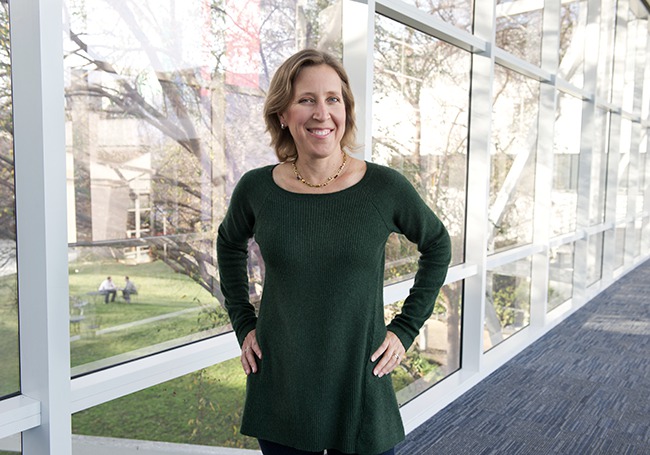
Straightforward and unflashy, Susan Wojcicki doesn’t come off like the most powerful woman in advertising that Forbes and others have labeled her. When we meet outside her office at the Googleplex in Mountain View, she’s dressed in jeans and a simple maroon top and speaks with an almost self-deprecating lilt.

But as the search giant’s senior vice president of advertising and commerce, she is indeed the exec leading the development of some of the most disruptive ad technologies of the past half-century. I interviewed Wojcicki (pronounced wo-JIT-ski) for my article in the current issue of Forbes on how Google is gunning for brand advertising, the image advertising still dominated by television and the dwindling pages of slick magazines.

After picking up “detox” lemonades at a juice bar, we walked past a T. Rex skeleton sculpture festooned with plastic pink flamingos to a set of tables to talk about how the company aims to wrest away brand advertising budgets, which still constitute the majority of ad spending worldwide thanks to the persistent popularity of television among advertisers. Over the slap of spikes and serves from a nearby volleyball court and the occasional caw of a crow resting in the nearby trees, she explained her vision of Google’s next big step beyond search and plain-vanilla display ads. This is an edited version of our conversation.

Google senior VP Susan Wojcicki

Google senior VP Susan Wojcicki

Q: Lots of brand marketers and agencies say they can get truly large audiences more easily on TV than on YouTube or elsewhere online. Why haven’t online ads been able to provide similar branding opportunities as TV and other traditional media?

A: Most advertising is a portfolio of different types of advertising. TV definitely is effective for lots of advertisers. If we want to talk about the long-term future, the question is: Where is TV going? Will all TVs be Internet-enabled? And if they are Internet-enabled, what does your TV look like then? Is your TV then basically a screen attached to your computer in your living room? There could be all different types of things your TV looks like in the future.

Q: You still hear the argument that TV is a lean-back medium and people in that kind of environment are always going to be more receptive to brand messaging. Are people ever going to be as receptive online?

A: Even in TV advertising, they try to target specific types of users. That’s why they’ll say, “We want users who watch sports,” because that means a certain type of demographic. Users are opting into seeing specific shows on TV, and I think it’s similar with digital. They are choosing specific shows to see.

I’m not really sure that lean-back vs. interactive necessarily means that the user is more or less receptive. It’s counterintuitive that something where you’re engaging, you’re less receptive. If users are engaging with something, they’re choosing to see something. That’s the whole concept of what we’re doing with TrueView [YouTube ads that viewers can skip and that advertisers pay for only if they’re viewed], where users are choosing to see something, so they’re engaging with it. …

Read the rest of the interview.